



Medical Card vs Critical Illness Insurance in Malaysia: Do you need both?
They both sound like health insurance, but they protect different things. Here's the breakdown.

Many Malaysians believe that once they have a medical card, they're fully protected against health-related financial risks. After all, if you're hospitalised, your medical card can help cover treatment costs. Problem solved, right? Not quite.
What many Malaysians don’t realise is that serious illnesses often involve more than just the hospital bills. A cancer diagnosis, stroke, or heart attack could mean months away from work, reduced income, additional caregiving expenses, and lifestyle changes that aren't covered by a medical card.
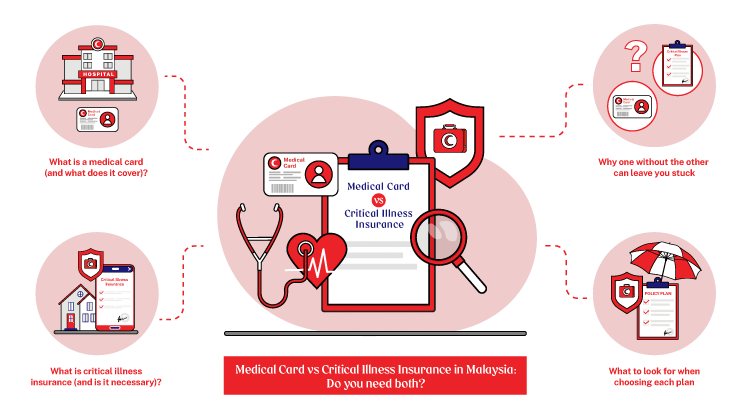
So, do you need both a medical card and critical illness insurance?
For many Malaysians, the answer is yes. A medical card and critical illness insurance aren't the same thing, and for many of us, having only one leaves a gap in our financial safety net.
Nearly 60% of Malaysians still don't have any insurance or takaful coverage at all, and they might realise too late that a medical card is not enough.
Key highlights on medical card vs critical illness insurance
- A medical card covers your hospital and treatment bills. However, it does not cover your rent, loan repayments, or income while you're recovering.
- Critical illness insurance pays you a lump sum in cash when you're diagnosed with a serious illness. You can use it however you need it.
- Healthcare costs are rising faster than most salaries. For context, Malaysia's medical inflation rate is projected to rise to 16 per cent in 2026 from 15 per cent in 2025, while companies are forecasting average salary increments of 5.33% for executives and 5.01% for non-executives in 2026.
- According to the National Health and Morbidity Survey (NHMS) 2025, chronic diseases among the elderly are increasing with 39% having diabetes, 73% having hypertension, and 76% having high cholesterol.
- Both medical card and critical illness insurance work best together, as one covers your treatment, while the other keeps your finances afloat while you recover. The right coverage depends on your budget, life stage, and financial responsibilities.
What is a medical card (and what does it cover)?
A medical card is a health insurance plan that covers the cost of being treated or hospitalised in a private hospital. For many Malaysians, a medical card provides peace of mind because it helps reduce or manage large out-of-pocket medical expenses.
For example, if you're admitted to the hospital due to dengue, appendicitis, or a major surgery, your medical card may help cover a sizable portion of the eligible treatment costs.
Depending on your medical plan, it may cover:
- Room and board
- Surgical and specialist fees
- ICU stays
- Diagnostic tests (scans, blood work, X-rays)
- Ambulance fees
- Outpatient treatment (depending on your insurance plan)
What your medical plan usually doesn't cover:
- Your income while you're on medical leave
- Daily living expenses during recovery
- Mortgage or loan repayments
- Caregiving costs or home modifications after discharge
Heads up: If your only medical insurance coverage is your employer's group insurance, it ends the moment you leave that job. A personal medical card stays with you no matter where you work.
What is critical illness insurance (and is it necessary)?
Critical illness insurance, or CI coverage, provides a lump-sum cash payout if you're diagnosed with a covered serious illness. Unlike a medical card, the payout is not tied directly to hospital bills.
Instead, you receive cash that can be used however you need, whether that's replacing lost income, covering household expenses, servicing a loan, or paying for treatment not covered by your medical card.
Most Malaysian policies cover a minimum of 36 critical illnesses as defined by the Life Insurance Association of Malaysia (LIAM). The 5 health issues that can majorly affect your life include:
- Cancer
- Heart attack
- Stroke
- Kidney failure
- Coronary artery disease
According to LIAM's 2025 annual report, medical claims rose 5.3% from RM8.9 billion in 2024 to RM9.4 billion in 2025. Medical inflation, running at 11% to 12% annually, is a major driver, compounded by more people being diagnosed withcritical illnesses and an ageing population.
Each condition comes with a specific definition, so it's worth reading the fine print before you sign up.
This is why CI coverage is increasingly becoming part of a comprehensive financial protection plan. For many Malaysians, CI coverage is the cushion that eases financial stress during the recovery stages.
Common uses include:
- Replacing lost income
- Paying household expenses
- Covering mortgage or rental payments
- Funding rehabilitation and recovery
- Supporting family members or caregivers
Comparison: What is the difference between a medical card andcritical illness insurance in Malaysia?
| Feature | Medical Card | Critical Illness Insurance |
| Payment type | Hospital & treatment bills | Lump-sum cash payout |
| Trigger | When you're hospitalised/treated/during hospital treatment | |
| How payout is used | Paid to hospital (or reimbursed) | |
| Covers income loss? | No | |
| Covers daily expenses? | No | |
| Covers outpatient? | Depends on plan | |
| Key gap it fills | High medical bills | |
| Tax relief | Yes, under medical insurance relief (check with LHDN) |
Real-life scenario: Why one without the other can leave you stuck
- Scenario A: Medical card only
Farrah, 38, has a good medical card. She's diagnosed with breast cancer. Her medical card covers her surgery and chemo, and the total bill amounts to RM120,000. Her medical card covers it all.
But Farrah’s on medical leave for 8 months. Her salary stops. Her rent doesn't. Her kids' tuition doesn't. By the time she recovers, her savings have been drastically reduced from just getting by.
- Scenario B: Medical card + critical illness coverage
Same Farrah, same diagnosis. But this time, she also has a critical illness insurance policy. Upon diagnosis, she receives a RM150,000 lump-sum payout.
She uses it to cover 8 months of living expenses, make a partial payment on her home loan, and pay for post-treatment rehabilitation. She recovers and so does her finances. The hospital bill wasn't the problem. Life after the hospital was.
Note: Figures for the scenarios above are illustrative and may vary depending on policy terms.
So, do you need both? Here's a quick way to figure it out.
You should prioritise a medical card if:
- You have no hospitalisation coverage at all
- Your only protection is employer group insurance (which ends when you leave your job)
- You want cashless hospital access paying upfront
Add critical illness coverage if:
- You are a sole breadwinner - a spouse, kids, or elderly parents depending on your income
- You have a family history of cancer, heart disease, or stroke
- You don't have 6 to 12 months of savings as a buffer
- You have other financial commitments, like a property loan, car loan, or business debt
But if you can only afford one, which comes first?
For most people, a medical card is the foundation because it directly protects against hospital bills. Even without CI coverage, a good medical card can still cover treatment for critical illnesses.
That said, is critical illness insurance necessary? For breadwinners, the self-employed, and anyone without a financial buffer, the answer is yes. The question is less whether you need CI coverage, and more when you can get it in place.
What this looks like by life stage:
- Young and single (20s–early 30s): Start with a good medical card. Add a CI rider or early-stage plan when your budget allows. The younger you start, the lower the premium.
- Married with kids and a home loan: Both medical card and critical illness insurance plans are important here. If your income stops, your family feels it immediately. Aim for CI coverage worth a few years of your income.
- Self-employed or freelancing: Don't skip either. There's no employer sick-pay to fall back on, which makes both a medical card and CI coverage essential.
What to look for when choosing each plan
Best features of medical cards to look out for:
- Annual limit (RM100k–RM1+ million range): Look at annual limits that can reasonably keep up with rising hospital costs
- Restoration of limits: Can your limit reset mid-year if you use it up?
- Coverage for major treatments: For example, cancer, cardiac procedures, major surgeries
- Room and board limits: Higher limits give you more ward choices
- Panel hospital network: Bigger and closer is better
- Cashless admission: Avoids out-of-pocket upfront costs
- Co-insurance and deductible terms: Know what you still pay per claim
- Standalone vs rider: Standalone isn't tied to a life policy; a rider can be cheaper but comes attached.
Best features of critical illness plans to look out for:
- Number of illnesses covered: Standard is 36; some plans go up to 100+
- Early-stage CI coverage: Some plans pay out at early or intermediate diagnosis, not just late-stage (relevant for cancer)
- Multi-claim policy: Can you claim different critical illnesses over time?
- Sum assured: A common benchmark is 5 to 10 times your annual income
- Long-term premium: Make sure it's affordable over the full policy term, not just today
Find the right plan: Don't wait until you need it to wish you had it
The best time to get covered is before anything happens. A medical card is your first line of defence as it keeps your hospital bills from becoming a financial crisis. But critical illness insurance is what keeps your life from unravelling while you fight to get better.
If you need assistance figuring out the right combination for your situation, a Great Eastern Life Planning Advisor (LPA) can walk you through your options.
FAQs


Let our Life Planning Advisor
assist you to
Request a call back
Thank you for your enquiry. Fill in your details below and a Life Planning Advisor will get back to you within 48 hours.
Call times are Monday-Friday between 8.30am and 5.15pm (except Public Holiday).