



The sandwich generation in Malaysia: How to plan your finances without losing yourself in the middle
If you are juggling your children's school fees and parents' medical bills, then you are part of what’s known as the sandwich generation. It’s not easy, but there are ways to plan your finances so you can care for both generations, while looking after yourself too.
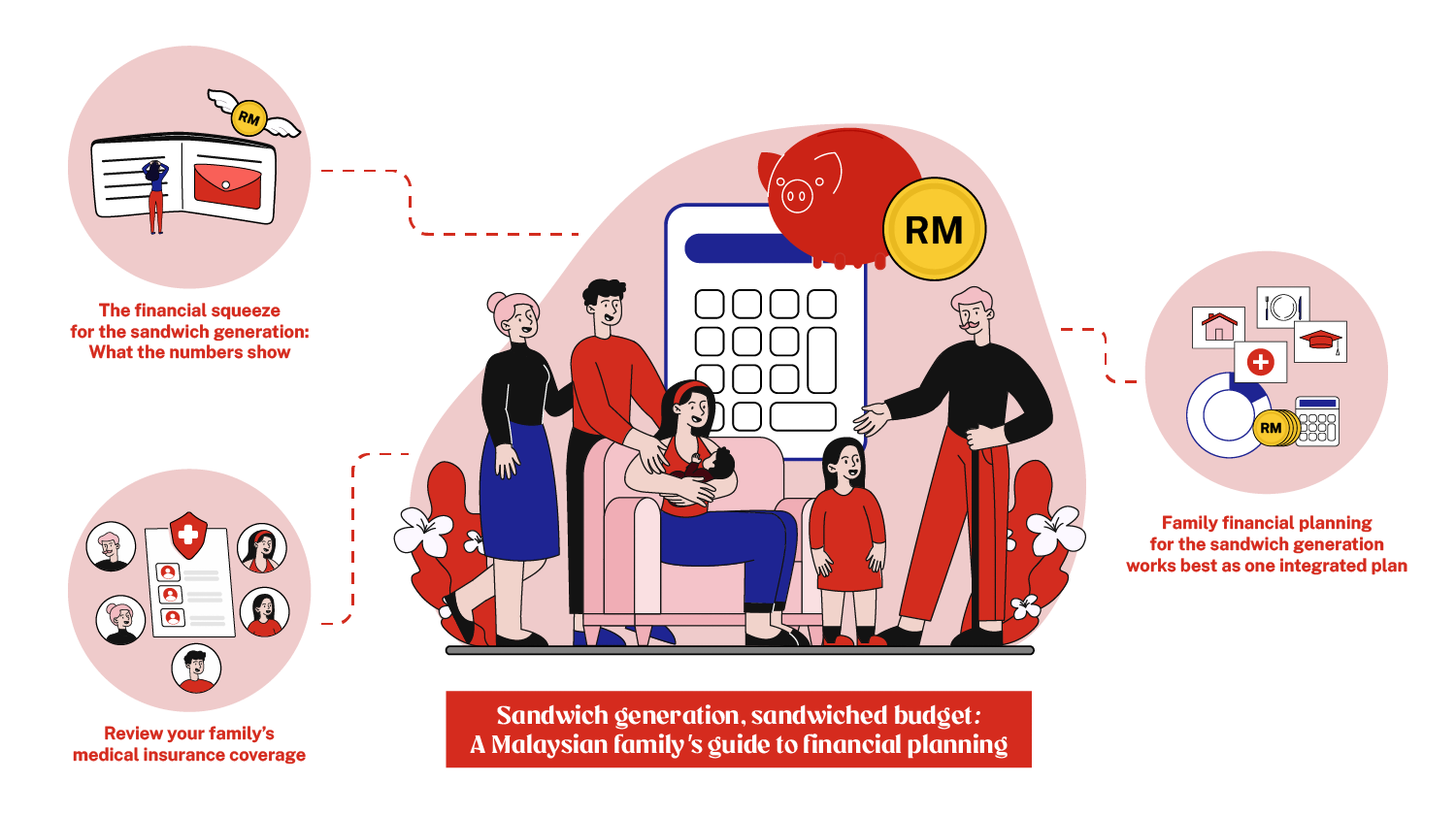
As a sandwich generation, financial planning could look like this—securing your own income and retirement, protecting your family with the right insurance (life, health, and critical illness), claiming every tax relief you're eligible for on both your parents and your children, and having an honest money conversation with your family before a crisis forces the decision for you.
It sounds like a lot, and it is. But it's manageable once you break it down.
Quick highlights
|
What is the sandwich generation, and why many Malaysians are in it?
The sandwich generation refers to adults usually in their 30s to 50s who are financially (and sometimes physically) supporting both their children and their ageing parents at the same time.
It's not a niche situation. Malaysians' sandwich generation finance struggles are becoming more common for two very clear demographic reasons:
- We're living longer. Life expectancy in Malaysia has climbed to around 76 years, up from 72.2 years in 2000. That's three more years, on average, that parents may need some form of support.
- We're having fewer children to share the load. Malaysia's total fertility rate has fallen to around 1.6–1.7 children per woman. This is below the replacement level of 2.1, and a drop from 4.9 in 1970. So, that means there are fewer siblings to split parents' medical bills and caregiving duties with.
In countries like Malaysia, there’s still strong cultural expectation in most communities where children look after their parents, and it's easy to see why many elderly Malaysians live with their children or extended family.
According to Malaysia's 5th National Population and Family Survey, 70 per cent of elderly people live with their children or extended family, while 95.3 per cent of elderly parents have received at least one form of support from their children, ranging from cash and daily necessities to transportation, personal care and help with household chores.
The financial squeeze for the sandwich generation: What the numbers show
The data backs it up. For starters, the age group most likely to be sandwiched, 35 to 44 years old, is also the group facing the most bankruptcy cases. Data shows personal loans were the main cause of bankruptcy, making up 46.63% of all cases between 2021 and 2025.
Second, many parents haven't saved enough to be fully self-sufficient in retirement, which is part of why support is needed from their adult children. According to the 2022 data by the Malaysia Ageing and Retirement Survey (MARS) by Universiti Malaya’s Social Wellbeing Research Centre, individuals aged 40 to 50 allocated an average of RM234 to their parents, representing 7.4% of the average monthly income for the same year.
None of this means a crisis is inevitable. It means the planning matters more than it might for other life stages.
Building your sandwich-generation financial plan
Family financial planning for the sandwich generation works best as one integrated plan rather than three separate plans (one for you, one for your kids, one for your parents). Here are 8 things you can do or consider when building a financial plan for your family.
i) Map the full picture
Before you plan anything, list everything on a page, such as every recurring commitment across all three generations. It’s not just the big ones, but the smaller recurring costs too, such as your parents' regular medication, your child's tuition or enrichment classes, your loan repayments, household bills you split with siblings, and so on.
Here’s a quick example of a simple monthly "3-generation budget" table, based on a monthly household income of RM8,000.
| Category | Monthly Amount (Example) | % of income (Example) |
Your own essentials (housing, food, transport) | RM3,000 | 37.5% |
Your own EPF/retirement savings (voluntary top-up) | RM400 | 5% |
Children's expenses (school, tuition, childcare) | RM1,200 | 15% |
Parents' expenses (allowance, medication, check-ups) | RM800 | 10% |
| Emergency fund contribution | RM500 | 6.25% |
Insurance premiums (health, life, critical illness) | RM600 | 7.5% |
| Discretionary/buffer | RM1,500 | 18.75% |
| Total | RM8,000 | 100% |
Note: This is a rough example, as your actual allocation will depend on your income, number of dependants, and whether you're sharing costs with siblings. The point of the table is to see all three generations on one page, instead of three separate documents or tabs.
ii) Protect your own income
If something happens to you, such as a serious illness, an accident, or a long hospital stay, both your children and your parents lose their main financial safety net. This is why protecting your own income, be it through adequate health, critical illness, and disability-related coverage, is not putting yourself first for its own sake. It's also about protecting the two generations who depend on you.
iii) Secure your own retirement
You might want to put every spare ringgit into your parents and your kids, while sidelining your own EPF or retirement savings. But if your own retirement isn't funded, you risk becoming financially dependent on your own children in the future, repeating the exact “sandwich-generation situation” you're trying to manage today.
Even a small, consistent contribution, through EPF voluntary contributions, PRS (Private Retirement Scheme), or a wealth accumulation plan, allows compounding to work in your favour.
iv) Cushion for healthcare costs
Healthcare is probably the hardest to predict, and it could derail your financial plans entirely. Costs such as private hospital bills, ongoing medication for chronic conditions, and specialist consultations can build and escalate quickly, especially as parents get older.
A combination of adequate medical coverage (yours, and your parents' if still insurable) plus critical illness protection helps absorb the financial impact of a major diagnosis without draining the funds you've set aside for your children's education or your own retirement.
v) Save for your kids' future without shortchanging today
Education savings matter, but they shouldn't affect your emergency fund or your own coverage or protection. Consider a
consistent contribution to a children's education or savings plan rather than large, irregular lump sums that compete with your parents' medical bills.
vi) Claim the tax relief and government support you're entitled to
These claims come in handy in family financial planning, so be sure to fully utilise them.
- Parents' medical relief
LHDN allows tax relief of up to RM8,000 for medical treatment, dental treatment, and carer or nursing home expenses for your parents, provided they are Malaysian residents and the treatment is provided in Malaysia by a registered medical practitioner.
- Children's reliefs
Education, medical, and childcare-related tax reliefs reduce your chargeable income. Check the updates yearly, as amounts are reviewed with each Budget.
- Government elderly support
The Department of Social Welfare (JKM) runs aid schemes such as Bantuan Warga Emas (also known as Bantuan Orang Tua) for lower-income senior citizens, alongside programmes like Sumbangan Tunai Rahmah (STR).
These are based on specific income brackets, so most middle-income sandwich generation households might not qualify. And that’s why personal financial planning needs to be the backbone of the plan.
Reminder: Keep receipts for at least seven years, as required by LHDN, and revisit this list every tax season.
vii) Build (or rebuild) your emergency fund
A "just in case" fund can quickly deplete by whichever generation with the biggest emergency that month or year. Instead, consider splitting your emergency fund into separate accounts, based on purpose, such as a parent care fund for sudden medical costs, and a children's fund for unexpected school or health expenses. Aim for a combined buffer of around six months of essential household expenses, not just your own.
viii) Talk about it before a crisis
Some of the hardest conversations happen in hospital corridors. Start an honest, low-pressure conversation with your parents about their savings, existing insurance and old-age care. At the same time, speak with your siblings about how caregiving costs and responsibilities can be shared.
It doesn't need to happen all at once, but a short, calm conversation started early is better than one forced by an emergency.
Common mistakes to avoid
- Treating it as three separate budgets
Without a combined plan, it's easy to overcommit to one generation without realising the impact on the other two.
- Not addressing your own insurance or retirement savings
It might feel like the responsible thing to do in the moment, but it could also increase the risk to everyone who depends on you.
- Assuming government aid will cover the gap
The elderly assistance schemes in Malaysia could be helpful if you fit the requirements, but they are not a substitute of your own plan.
- Leaving tax reliefs unclaimed
Take note of the expenses you can claim for, and ensure to stay updated on tax savings every year.
- Avoiding the money conversation with parents or siblings
This just means that if a crisis arrives, you have to less time to plan or deliberate.
Having a clear plan can make the decisions easier
Being sandwiched between two generations is hard, but a clear plan, even a simple one, turns a scramble into something manageable.
If you're ready to review your family's protection and savings needs, speak to a Great Eastern Life Planning Advisor about building a plan that considers your children, your parents and your own financial future.
FAQs


Let our Life Planning Advisor
assist you to
Request a call back
Thank you for your enquiry. Fill in your details below and a Life Planning Advisor will get back to you within 48 hours.
Call times are Monday-Friday between 8.30am and 5.15pm (except Public Holiday).