



Retirement planning for late starters in Malaysia: Your catch-up playbook
Starting late doesn't mean starting from scratch. Discover practical ways to maximise your savings, protect your wealth, and build a retirement income that supports the lifestyle you want.

You're in your 40s or maybe early 50s. Life has happened and now, retirement doesn't feel like a distant milestone anymore. It feels real.
A search on “how to retire comfortably in Malaysia" will tell you the same thing, and that’s to start early, invest consistently, let compound interest do the work. While starting early has its advantages, starting later doesn't mean you've lost your chance.
What you need now is what to do today.
The statistics are encouraging, as voluntary EPF contributions surged 62% in 2024, and in the first half of 2025. Members making voluntary top-ups nearly doubled compared to the same period the year before. Saving for retirement at 40 or beyond is not a fringe behaviour. In fact, it's exactly what hundreds of thousands of Malaysians are doing.
With the right strategy, these years can become your most important wealth-building years. This guide explores how retirement planning can help late starters focus on what matters most.
Quick highlights
- Starting retirement planning after 40 isn't ideal, but it's far from too late. As of end-2025, only 41.2% of active EPF formal-sector members had reached the Basic Savings target of RM240,000 in their EPF savings. The Basic Savings has been increased to RM270,000 for 2026.
- The goal isn't just a big number in your account. It's having enough reliable monthly income to live well throughout retirement.
- Your highest-earning years are right now. You can maximise EPF voluntary contributions, clear debt(s), and stack multiple income sources to close the retirement gap.
- Medical inflation in Malaysia runs at 10% to 15% a year. Going uninsured would be a quick way to undo years of catch-up savings.
- Small financial improvements made consistently over the next 10 to 20 years can make a meaningful difference.
Can you still retire comfortably if you start planning in your 40s or 50s?
Yes. While starting early provides more time for savings and investment growth, late starters can still improve their retirement outlook by increasing savings rates, reducing debt, extending working years where possible, and creating multiple income sources.
The destination is the same. The route is just a bit more intense.
Here's what "winning" looks like for a late starter in Malaysia:
- Your income is your greatest asset right now
Most Malaysians reach peak earnings between 40 and 55. This is the window to maximise contributions.
- The EPF voluntary top-up is an under-used tool
You can voluntarily contribute up to RM100,000 a year on top of your mandatory contributions. EPF paid a 6.15% dividend in 2025, making it one of the more stable retirement savings options for Malaysians.
- You need an income plan, not just a savings number
Having RM650,000 saved is not the same as receiving RM2,708 every month for 20 years. A retirement investment strategy that focuses only on building a big number, without a plan for how the money flows out, can still leave you in trouble. Income is the goal. The savings are just the vehicle.
- Protection matters more now than ever
A single hospitalisation or serious illness at 50 can wipe out years of catch-up savings. The right coverage is a retirement essential.
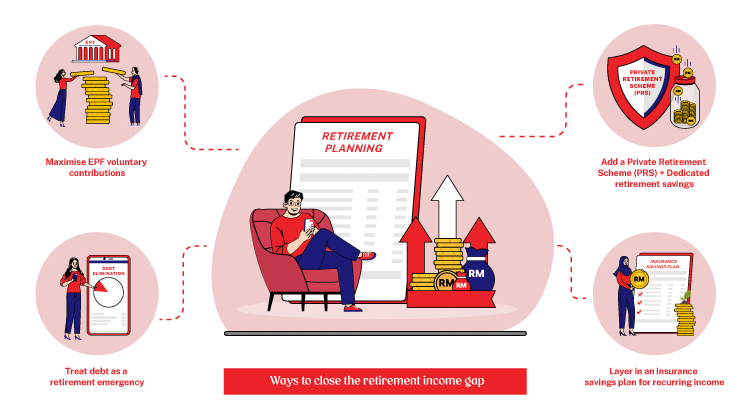
Start by understanding where you stand today
The first step isn't changing your investments or buying a new financial product. The most important thing you can do right now is calculate your retirement savings.
Ask yourself:
- How much have I accumulated in my EPF account?
- Do I have savings outside of EPF?
- Am I investing regularly?
- Do I still have outstanding loans?
- What are my monthly expenses today?
- What lifestyle do I hope to enjoy during retirement?
Think of this as your retirement financial health check.
What to calculate right now:
- Your current EPF balance: Check it on the via EPF app or website.
- Your projected EPF balance at 60, based on your current contribution rate and a 6% annual dividend.
- Your estimated monthly EPF drawdown if you retire at 60 with that balance (divide by 240 months for a 20-year period).
- The gap between that monthly income and what you need to live on. The EPF Belanjawanku 2024/2025 puts the minimum decent living cost for a single retiree at RM2,690 per month.
- Your total outstanding debts e.g. mortgage, car, personal loan, credit cards.
- Your existing supplementary savings e.g. Private Retirement Scheme (PRS), unit trusts, fixed deposits, ASB, insurance savings plans.
The income gap formula:
(Monthly expenses needed in retirement) − (All projected monthly income sources) = your retirement income gap (the number you are trying to close)
Here’s an example: Meet Dzul, 46 years old.
- He earns RM7,500 per month
- He has RM120,000 in EPF and RM15,000 in PRS
- He has 8 years left on his housing loan
At his current contribution rate (11% employee + 12% employer = RM1,725/month) and assuming a 6% EPF dividend, Dzul will have accumulated roughly RM430,000 by age 60. This is barely above the Basic Savings level.
- His monthly EPF drawdown: Approximately RM1,792
- His estimated monthly need: RM4,500
- His income gap: Approximately RM2,700 per month. This is the number he needs to close. Every strategy below is aimed at exactly that.
6 moves that close the retirement income gap, even after 40
#1: Maximise EPF voluntary contributions
If you're saving for retirement at 40 or later, this is a powerful tool.
- On top of your mandatory contributions, you can voluntarily put in up to RM100,000 a year through Voluntary Excess (for salaried workers) or i-Saraan (if you're self-employed).
- Voluntary contributions are eligible for income tax relief under the RM4,000 EPF contribution relief, effectively giving your savings a return boost before the money is even invested.
- The compound effect on a late starter: An extra RM1,000 a month in EPF voluntary contributions starting at age 45, at 6% dividend, adds approximately RM285,000 to your EPF balance by 60. That translates to an additional RM1,187/month in retirement income over a 20-year period.

What to do today:
- Log into KWSP i-Akaun → Increase Savings
- Set up a monthly auto-debit (Auto Simpan) for an amount you can comfortably commit to. Even RM200 a month makes a difference.
#2: Treat your debt like the retirement emergency it is
Every Ringgit of debt you carry into retirement is a Ringgit that has to come out of your retirement income. Here’s an example of priority order for debt elimination (highest interest rate first):
- Credit cards: At 15% to 18% interest per annum, paying these off is effectively a guaranteed 18% return.
- Personal loans: Clear these as quickly as possible.
- Car loans: Consider whether a paid-off car versus a financed car makes sense as you head into your 60s.
- Housing loan: Aim to have this fully settled by retirement age. If that’s not realistic, at least factor the monthly payment into your retirement income calculations from day one.
One thing people don't realise is that settling a housing loan at 58 instead of 65 can free up a few thousand Ringgit monthly. That's a retirement income upgrade achieved purely by settling what you owe.
If you receive a bonus, a commission windfall, or an inheritance, direct it at debt first, then at retirement savings.
#3: Add a Private Retirement Scheme (PRS) for Tax Relief + Dedicated Retirement Savings
PRS contributions earn up to RM3,000 per year in income tax relief, and this is completely separate from your RM4,000 EPF relief. You can claim both at the same time.
If you’re in the 24% tax bracket, RM3,000 in PRS contributions saves RM720 in tax, effectively a 24% guaranteed return in Year 1 before any fund performance.
What are PRS funds?
As a retirement investment vehicle, PRS funds are actively managed and come in different risk profiles, conservative (bond-heavy, good for those closer to retirement) or growth-oriented (equity-focused, for those with more than a decade to go).
A simple and practical guide based on age:
- 40–49 years old: A moderate-to-growth fund works well here. You still have 11–20 years for the market to do its thing.
- 50–55 years old: Start shifting toward a more balanced or conservative mix. At this stage, protecting what you have is just as important as growing it.
- 55 years old and above: PRS funds become accessible without penalty from age 55. This is a handy income bridge in the early years of retirement.
One thing to bear in mind: Don't put everything into a single provider or fund type. Even within PRS, spreading across a couple of fund categories is better than putting all your eggs in one basket.
#4: Layer in an insurance savings plan for recurring income
EPF and PRS are savings vehicles. An insurance savings plan such as an endowment or retirement income plan adds something neither can offer — guaranteed, predictable income at a specified date, regardless of market performance.
For late starters, certainty often matters more than optimisation. Knowing that you will receive RM2,000 every month from age 60 to 80, regardless of what the market does, is a form of retirement income security.
Here's how it generally works:
- You pay a fixed premium for a set term e.g. 10 or 15 years.
- At maturity (or at a specified retirement age), the plan pays out either a lump sum or a set monthly income.
- Life coverage is typically included. So, if you pass away before maturity, your dependents receive a payout.
- Some plans let you add riders for critical illness or disability, turning a savings vehicle into a protection-plus-income product
And the earlier you start within your late-start window, the lower your premium for the same benefit. There's a meaningful cost difference between starting at 42 and starting at 52.
Here's the bonus most people don't think about. A well-structured insurance savings plan also protects your EPF from emergency withdrawals. If something happens to your child and you need funds urgently, the insurance plan's critical illness payout handles it, and you don't have to withdraw your EPF savings, keeping your retirement income intact.
#5: Consider delaying your retirement by one or two years
This is the catch-up strategy most people resist emotionally but which has a mathematical impact.
Delaying retirement from 60 to 62 has a compounding effect:
- Two more years of EPF contributions (employer + employee): At RM7,500 per month salary, that's about RM40,500 added to your EPF account.
- Two more years of 6% EPF dividend on the full balance: On RM400,000, that's roughly RM49,000 in additional dividend.
- Two fewer years of drawdown: Your savings now need to last 18 years instead of 20, which means your monthly payout from the same balance actually goes up.
Flexible retirement is also an option. Consulting, freelancing, part-time work, or turning a hobby into income in your early 60s lets you keep some money coming in while drawing less from your savings. Even RM2,000 a month from part-time work means your retirement fund is depleting at a slower rate.
#6: Protect everything you've built because healthcare can undo everything
A retiree at 65 could easily need between RM300,000 and RM500,000 just for basic healthcare across their retirement years, and that's before factoring in any chronic illness management.
Without proper coverage, one critical illness in your late 50s could force you withdraw from your EPF account early, liquidate investments or assets at a bad time, borrow, or take on new debt right when you should be wrapping it up.
Here's a late-starter insurance checklist:
- Medical card or hospitalisation plan: Opt for one with lifetime renewability.
- Critical illness coverage: A lump-sum payout for the 36 most common critical illnesses in Malaysia. Cancer, heart attack, and stroke alone account for more than 70% of CI claims in Malaysia.
- Life coverage of at least 5× to 10× your annual income: This is especially for those who still have dependants or outstanding loan(s).
- A retirement income plan with a disability waiver: If you become totally and permanently disabled before you retire, your premiums are waived and your full benefit is preserved.
Note: Remember that getting comprehensive medical and CI coverage at age 45 costs less than at age 55. Every year you delay protection coverage, premiums could go up and the health declaration could become more complicated.
Building a multi-source monthly retirement income
A retirement income plan built across three to five sources is more resilient, more sustainable, and less psychologically stressful than a single EPF lump sum.
| Income source | Monthly Amount (Example) | Notes |
| EPF drawdown | RM2,000 | Based on RM480,000 balance / 20 years |
| PRS income | RM500 | RM120,000 accumulated, drawn over 20 years |
| Insurance plan payout | RM1,500 | Guaranteed monthly income from endowment plan |
| Rental income | RM1,000 | Second property / room rental |
| Part-time/consulting | RM1,500 | First 3 to 5 years of retirement |
| Total | RM6,500 | Against a target of RM6,400 (80% of RM8,000 income) |
The best time to start is now
There is a version of retirement that still looks good from where you are today. It may require more discipline and more intentional decisions in the next 10 to 15 years, but it is achievable.
Start with your retirement income gap. Know your number. Then speak to a Great Eastern Life Planning Advisor who can help you build a retirement plan that empowers your golden years with pride.
FAQs


Let our Life Planning Advisor
assist you to
Request a call back
Thank you for your enquiry. Fill in your details below and a Life Planning Advisor will get back to you within 48 hours.
Call times are Monday-Friday between 8.30am and 5.15pm (except Public Holiday).