








The Singaporean guide to insurance – by age (according to AI)
Financial Planning 101: an unbiased, AI-curated breakdown of what you really need, might consider, and don’t need at all in your 20s, 30s, 40s and beyond

Insurance can sometimes feel like a jungle — full of jargon, overloaded with marketing speak, and an overwhelming number of options here in Singapore like health, life, investment-linked, disability, travel, home, motor, maid, critical illness and more.
So, what do you actually need?
This article was written entirely by AI — no commissions, no bias, no human sales pitch. Just a data-informed, logic-based breakdown of what types of insurance are worth considering at each life stage, based on your risks, lifestyle, family responsibilities, and wealth-building goals.
Before we proceed (a human note)
This article is meant to empower you, our customer, to make smarter, more confident decisions about insurance.
We believe in putting our customers’ interest first. As such, the primary goal of this article is to help you navigate the insurance space better.
Several prompts were used for AI to generate this article. The prompts given were for depth and clarity purposes only. Any edits made were only for formatting purposes or to check the accuracy of the data.
In your 20s: building your base
Your twenties are for financial foundation, not overcommitment. Start with essential protection and skip the bells and whistles.
✅ What you definitely need
1. Hospitalisation coverage (Integrated Shield Plan or equivalent)
Hospitalisation is expensive. Class B1/A ward stays can hit $10,000-$25,000 for serious events. If you haven’t upgraded your MediShield Life to a private insurer’s Integrated Shield Plan (IP), now’s the time. Premiums are lowest in your 20s, and you avoid underwriting surprises later.
2. Term life insurance (if you have dependents or liabilities)
Don’t assume life insurance is for the old. If your parents co-signed a student loan or you financially support them, a basic term life plan (not whole life) ensures they aren’t left with debt. A $500,000 term policy can cost as little as $20/month.
3. Personal accident insurance
You’re active, commuting, maybe even travelling. A decent personal accident plan covers fractures, mobility aids, and outpatient visits. For under $200/year, it’s a safety net that's good to have.
🟡 What you might consider
1. Critical illness (CI) coverage
You’re statistically less likely to get cancer, stroke, or heart disease now, but CI coverage is cheapest before age 30. A basic early-stage or multi-pay CI rider can future-proof your health planning. Consider starting small and scaling later.
2. Investment-linked policies (ILPs)
ILPs are often considered to be controversial. But if you have a high-risk appetite, strong income growth, and understand what you're buying, some newer ILPs offer flexible premiums and better cost structures.
3. Travel Insurance (when going abroad)
Still relevant for student exchanges, holidays, or working holidays. Single-trip plans cost under $50, while annual plans suit frequent flyers.
❌ What you probably don’t need
- Whole life insurance: Expensive and rigid. Better to buy term and invest the rest.
- Disability income plans: Not a must-have unless you're the sole breadwinner.
- Home/Motor Insurance (unless you're unusually settled): Most in their 20s don’t own property or cars yet.
In your 30s: protecting family and income
You’re likely in your career stride, maybe starting a family, buying a flat, or both. Your insurance strategy must now account for others, not just yourself.
✅ What you definitely need
1. CI coverage (Early stage, multi-pay if affordable)
CI claims spike in the 30s and 40s. One in four Singaporeans will develop cancer by age 75. Add to that stroke, heart attacks, and rare diseases — early-stage CI coverage buys time to recover without burning savings.
2. Disability income insurance
Losing the ability to work, even temporarily, can derail your finances. Disability income plans replace up to 75% of your salary if illness or injury prevents you from working. A must-have if you’re the main breadwinner.
3. Mortgage insurance (or term life with equal coverage)
If you own a flat and have a mortgage, protect your co-owner or heirs. A decreasing term plan or basic life insurance tied to your housing loan ensures your family isn’t saddled with debt.
4. Hospitalisation coverage (maintain or upgrade IP)
If you upgraded in your 20s, keep it. If you haven’t, do it now — once health issues arise, coverage exclusions kick in.
🟡 What you might consider
1. Whole life plans (especially for legacy or gifting purposes)
If you’re planning long-term wealth transfer, or want forced savings with guarantees, a participating whole life plan with multi-pay CI might suit you. But be very clear on the costs, lock-in, and breakeven point (often 15+ years).
2. ILPs (if you want investment exposure with discipline)
Some ILPs now allow flexible fund choices and even partial withdrawals. If you’re financially savvy, use them as structured investments with some insurance cover. Otherwise, buy term + invest separately.
3. Maternity or child-focused plans (if expecting)
Certain insurers offer prenatal/maternity riders that cover congenital illnesses, complications, and mother-child hospital stays. Not essential, but can help with peace of mind.
❌ What You Probably Don’t Need
- High-end motor insurance riders: Go for value, not gimmicks like car replacement concierge services.
- Redundant personal accident coverage if already well-covered under group or corporate plans.
In Your 40s: fortify and optimise
This is your highest earning decade — your liabilities are bigger, but so are your opportunities to lock in meaningful protection before health issues creep in.
✅ What you definitely need
1. Robust CI and health insurance
By now, serious illness risks increase sharply. Ministry Of Health data shows cancer incidence doubles from 30s to 40s, and private hospital stays can hit $40,000+ for major surgeries. CI + hospital plans are no longer optional.
2. Term life with sufficient cover
If your kids are still young or you’ve taken a late mortgage, ensure life cover stretches to when your financial obligations end — usually age 65 or your kids’ university graduation.
3. Long-term care (CareShield Life + supplements)
As of 2020, all Singaporeans are auto-enrolled into CareShield Life. Consider CareShield supplements from private insurers that offer up to $5,000/month disability payouts. Long-term care is one of the fastest growing financial burdens for aging families.
🟡 What you might consider
1. Annuity or retirement income plans
These are structured savings plans that pay a guaranteed income from, say, age 60 to 85. If you prefer a forced savings plan with payout certainty, this can supplement CPF LIFE later.
2. Wealth/legacy planning instruments
Think about whole life, universal life, or endowment plans to create a lasting gift, pay estate taxes, or support dependents with special needs.
3. ILPs (only if you're comfortable with risk)
Switching to an ILP now carries market risk. At this age, most are better off with pure investment accounts unless they already own ILPs from earlier years.
❌ What you probably don’t need
- Excessive short-term endowment plans: Many are inflexible and return less than inflation.
- Maternity insurance: unlikely to be relevant unless you're planning a late pregnancy.
In your 50s and beyond: preserve and protect
Now the goal is less about growth and more about protection, affordability, and preparing for the final stages of life.
✅ What you definitely need
1. Hospitalisation coverage (IP + Rider)
Claims peak in your 50s and beyond. If your private hospital IP becomes unaffordable, switch to a public A/B1 plan with a rider. Don’t drop coverage entirely — MOH estimates a 1 in 2 chance of hospitalisation every year after 65.
2. Long-term care planning (CareShield Life + supplement)
Disability can last years. Having a monthly payout for severe disability ensures you're not a financial burden to loved ones.
3. Legacy and estate planning
Now’s the time for will writing, CPF nominations, insurance nominations, and trust planning. Life insurance with payout certainty (e.g. whole life, universal life) can help create a tax-free estate.
🟡 What you might consider
1. Retirement income plans (if not already bought)
Structured annuity-style plans can provide a steady income during retirement, supplementing government retirement schemes. Evaluate yields, fees and terms carefully to find a plan aligned with your retirement goals.
2. Single-premium wealth transfer products
Insurance-based wealth transfer solutions may help efficiently pass assets to beneficiaries, reduce estate taxes, or provide targeted legacies. These require careful assessment of costs and benefits.
❌ What you probably don’t need
- Travel insurance (unless you travel frequently and have pre-existing coverage needs).
- New high-premium whole life plans: They have poor value if bought late due to limited compounding years.
AI final thoughts: you don’t need everything, just the right things
Many Singaporeans are either over-insured (and overpaying) or dangerously under-protected. The right insurance strategy evolves with age, income, and personal goals. Use this AI-generated, unbiased guide as a starting point — then tailor it to your life.
And if you remember one thing: insurance should protect your life, not control it.
Why humans are still important (another human note)
We hope this article was useful for your insurance/financial planning. By now, you may be asking yourself:
- Is AI accurate?
- If AI is, then why do we even need humans for our insurance needs?
For the full picture, we prompted the AI again to answer this:
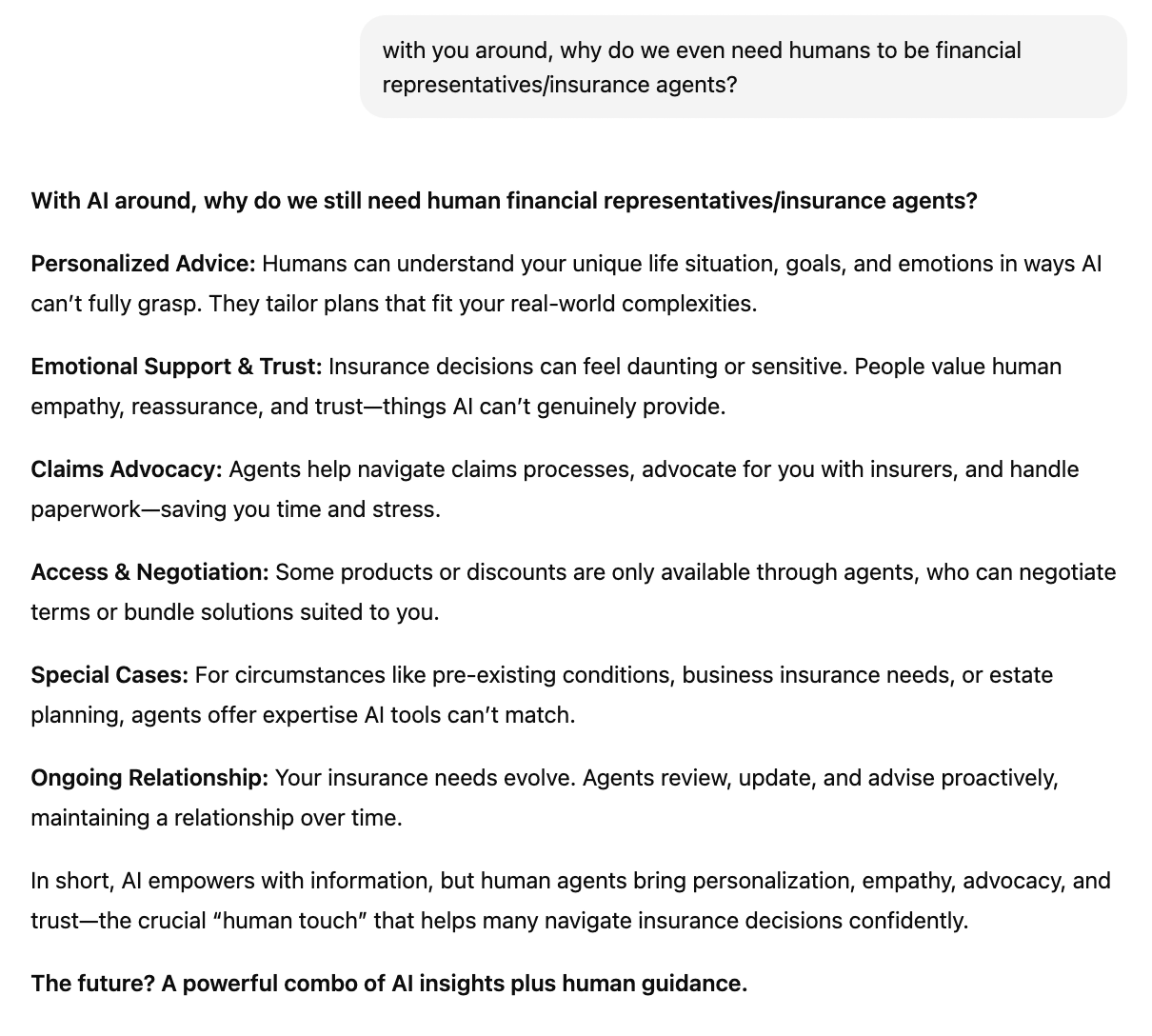
And there you have it (according to AI). Speak to one of our financial representatives if you need personalised support or guidance about AI’s suggestions today.



Let us match you with a qualified financial representative
Our financial representative will answer any questions you may have about our products and planning.
