








Top 10 most expensive cancers to treat
These cancers are known for incurring high treatment costs. Are you at risk?

Key takeaways:
- Cancer can be financially overwhelming. Some cancers may require complex treatments, specialised drugs, surgery, or lengthy care that can cost tens of thousands—or even over S$100,000.
- The true cost goes beyond medical bills. Cancer may also lead to loss of income, caregiving expenses, transport costs, and disruptions to major life goals.
- Early detection can make a difference. Regular screenings may help detect cancer earlier, potentially improving treatment options and reducing the need for more intensive care.
Managing a cancer diagnosis can be life-altering and financially draining. In Singapore, where 1 in 4 people are expected to develop cancer in their lifetime, being financially prepared to weather the cost is essential, as being caught off-guard can deplete your hard-earned savings.
How financially costly can cancer be? While cases vary, the estimated medical bills for cancer treatment can skyrocket quickly, amounting to S$150,000 in the case of a local acute myeloid leukaemia patient. Some cancers require complex treatments, prolonged hospital stays, rare drugs, or specialised therapies that drive the cost higher.
Take a quick look at some cancers that have been associated with complex, expensive treatments.
1. Acute Myeloid Leukaemia (AML)
Quick overview: This fast-growingvblood cancer affects the bone marrow and the production of white blood cells.
Who is at risk? Adults over 65 year old, especially males.
Treatment: Intensive chemotherapy, targeted therapy, or potential stem cell transplants are often recommended.
Estimated cost: Treatment for leukaemia varies from SS$70,000 to S$100,000 per patient, according to the Leukaemia & Lymphoma Foundation.
2. Brain / Central Nervous System (CNS) Cancers
Quick overview: Brain tumours typically originate from cells in the human brain. In the case of metastatic brain cancer, the tumour begins in other body parts before eventually spreading to the brainand surrounding tissues.
Who is at risk? People with certain gene mutations and those who have a history of radiation therapy or other cancers.
Treatment: Neurosurgery is often recommended after biopsy, followed by radiation or targeted therapy.
Estimated cost: Hospital bills at Ward B2/C, including brain tumour surgery and consultation fees, range between S$6,168 and S$11,537. Advanced treatments incur higher costs. Proton beam therapy, a precision radiation treatment often used for brain and spinal cancer, cost between S$20,000 and S$90,000.
3. Pancreatic cancer
Quick overview: Based on the point of origin, pancreatic cancer can be categorised into two common types: exocrine pancreatic cancer makes up over 90% of all pancreatic cancer cases, while neuroendocrine pancreatic cancer (PNETs) are relatively rare.
Who is at risk? Age is a big risk factor, particularly for those aged 50 to 80. High sugar consumption can alsoincrease your likelihood of developing pancreatic cancer by up to 87%.
Treatment: Surgery and chemotherapy, supported by nutritional care.
Estimated cost: Based on Ministry of Health estimates, hospital bills (inclusive of surgery fees, anddepending on ward class) range between S$12,407 and S$46,907.
4. Esophageal cancer
Quick overview: This cancer usually begins in the cells lining the esophagus, the hollow tube that transports the food from your mouth to the stomach.
Who is at risk? Heavy drinkers, habitual smokers, those with gastrooesophageal reflux disease (GERD), obese patients with a high tendency of acid reflux, people with existing oesophageal strictures, and people suffering from achalasia.
Treatment: Surgery (such as the minimally invasive endoscopic resection or the more complex esophagectomy) is used to remove cancerous cells. Other treatments include chemotherapy, radiation, targeted drug therapy, and immunotherapy.
Estimated cost: Surgeon fee benchmarks at private hospitals for esophagectomy can reach up to S$28,885.
Gastroscopy, a minimally invasive procedure used to diagnose esophageal cancer, is expected to cost around S$1,853 - S$2,943 in surgeon fees, with up to S$1,308 in an aesthetist fee and S$450 in daily doctor attendance fee.
5. Small-cell lung cancer
Quick overview: This rare, fast-growing lung cancer accounts for 10-15% of lung cancer cases in Singapore. If you have an extensive smoking history or aged between 50 to 80, consider
getting a low-dose CT (LDCT) screening annually to screen for this disease.
Who is at risk? This particular type of lung cancer is strongly linked to smoking. Other risk factors include exposure to second-hand tobacco, outdoor and household air pollution, and radon therapy.
Treatment: This cancer can be removed with surgery if it has not spread beyond the lung. In addition to surgical intervention, chemotherapy and radiation therapy are commonly used to kill cancer cells or relieve symptoms.
Estimated cost: Lung resection surgery and hospitalisation bills are estimated to cost up to S$40,143 in a public hospital (Ward A) or up to S$88,885 in private hospitals.
6. Ovarian cancer
Quick overview: Originating in the ovaries, this is the fifth most common cancer affecting Singaporean women and one of the hardest cancers to detect.
Who is at risk? Having a family history of ovarian cancer heightens the risk, although only 10-15% of ovarian cancer cases can be attributed to genetic heritage.
Treatment: Surgical treatment ranges from the minimally invasive laparoscopy for early-stage evaluation to the more extensive laparotomy. Before or after surgery, patients may undergo cycles of chemotherapy to kill cancerous cells.
Estimated cost: Fee benchmark for laparotomy (private hospitals only) ranges from S$5,450 to S$11,009, per Ministry of Health estimates.
For hysterectomy, total hospital bills range between S$3,759 and S$20,649, depending on the ward class and procedure, or up to S$53,336 for private hospitals.
7. Stomach (gastric) cancer
Quick overview: This cancer is often influenced by chronic infection with the Helicobacter Pylori, a bacterium living in the mucous lining of the stomach. It is the eighth most common cancer among men in Singapore.
Who is at risk? Certain lifestyle choices such as smoking, a salt-rich diet, and heavy alcohol use can heighten your risk of developing stomach cancer. Chronic gastritis is another common risk factor, so be sure to pay attention to your gastric health and dietary choices.
Treatment: The location and the stage of cancer will determine your treatment option. Surgery is used to removeas much cancer as possible, and can be accompanied by chemotherapy.
Estimated cost: Gastrectomy, a surgical procedure to remove all or part of the stomach, can cost over S$15,300 in total hospital bills at a public hospital for Ward B2 Class. At private hospitals, the surgeon fee can reach up to over S$25,000 while an additional doctor’s inpatient attendance fee per day can cost up to S$450.
8. Multiple myeloma
Quick overview: Diagnosed in more than 100 patients in Singapore every year, myeloma occurs when malignant plasma cells in the bone marrow grow out of control, outnumbering other blood cells essential to the body’s functions.
Who is at risk? The risk of myeloma increases with age, particularly after age 55 and above. Men also have a higher likelihood of being diagnosed by 1.5 to 2X.
Treatment: While researchers are still working toward a complete cure for multiple myeloma, the disease is highly treatable. Modern therapies and effective treatment strategies have enabled a good number of patients to manage the disease effectively — slowing the progression and, in some cases, achieving long-lasting remissions.
This includes a combination of chemotherapy and “novel agents”, medicines that target cancer cells directly without affecting non-cancerous cells.
Estimated cost: The mean monthly cost for patients in the first-line treatment (the first treatment given for a disease) is S$5,798.44, while the cost for each subsequent line of therapy is estimated to increase by at least 30%. The rise in cost estimate is due to the newer agents used and the lack of generic alternatives for older drugs commonly used in the first line.
9. Hodgkin lymphoma
Quick overview: Lymphoma refers to blood cancer that develops in the lympathic system, particularly affecting white blood cells called lymphocytes. In Singapore, lymphoma stands among the most commonly diagnosed cancers — fourth among males and fifth among women. Hodgkin Lymphoma, a less common type of this disease, is characterised by the presence of specific abnormal cells called Reed-Sternberg cells.
Who is at risk? Hodgkin lymphoma is most prevalent among people in early and late adulthood, particularly between 15-40 years of age, and 55 years and above.
Treatment: Hodgkin Lymphoma is considered a highly curable cancer with a variety of treatment options. The common options include chemotherapy, radiation therapy, targeted therapy, monotherapy, and bone marrow transplant.
Estimated cost: Day surgery and outpatient care for lymphoma cases in public hospitals can cost over S$900 (if subsidised) or approximately S$4,350 (if unsubsidised).
For private hospitals, the cost can be twice as expensive, with a typical bill of up to S$9,149.
10. Non-Hodgkin Lymphoma (NHL)
Quick overview: The main difference between Hodgkin and Non-Hodgkin Lymphoma is a specific cell called Reed-Sternberg. When Reed-Sternberg cells are absent, the lymphoma is classified as non-Hodgkin. Although more common than the Hodgkin variant, non-Hodgkin Lymphoma may be less curable.
Who is at risk? Non-Hodgkin lymphoma can strike at any age, but it mainly affects adults aged 60 or older. Although genetic inheritance is not a major factor, existing family history of lymphoma slightly increases your risk factor. Having a weakened immune system or a history with certain types of infection (such as H.pylori and the Epstein-Barr virus) may also put you at greater risk of this disease.
Treatment: Fast-growing lymphoma should be addressed promptly, while slow-growing lymphoma can be monitored before any treatment is decided while it presents no symptoms.
In addition to chemotherapy and targeted therapies, the emergence of innovative treatments like the chimeric antigen receptor (CAR) T-cell therapy offers a ray of hope for patients with complex or relapsed lymphoma cases.
Putting the cost into perspective
The cost of managing cancer without financial protection from critical illness coverage can deplete your savings and disrupt your personal goals. Here’s a simple comparison.
The treatment for leukaemia can cost up to S70,000 to $100,000 per patient. With this amount, you can:
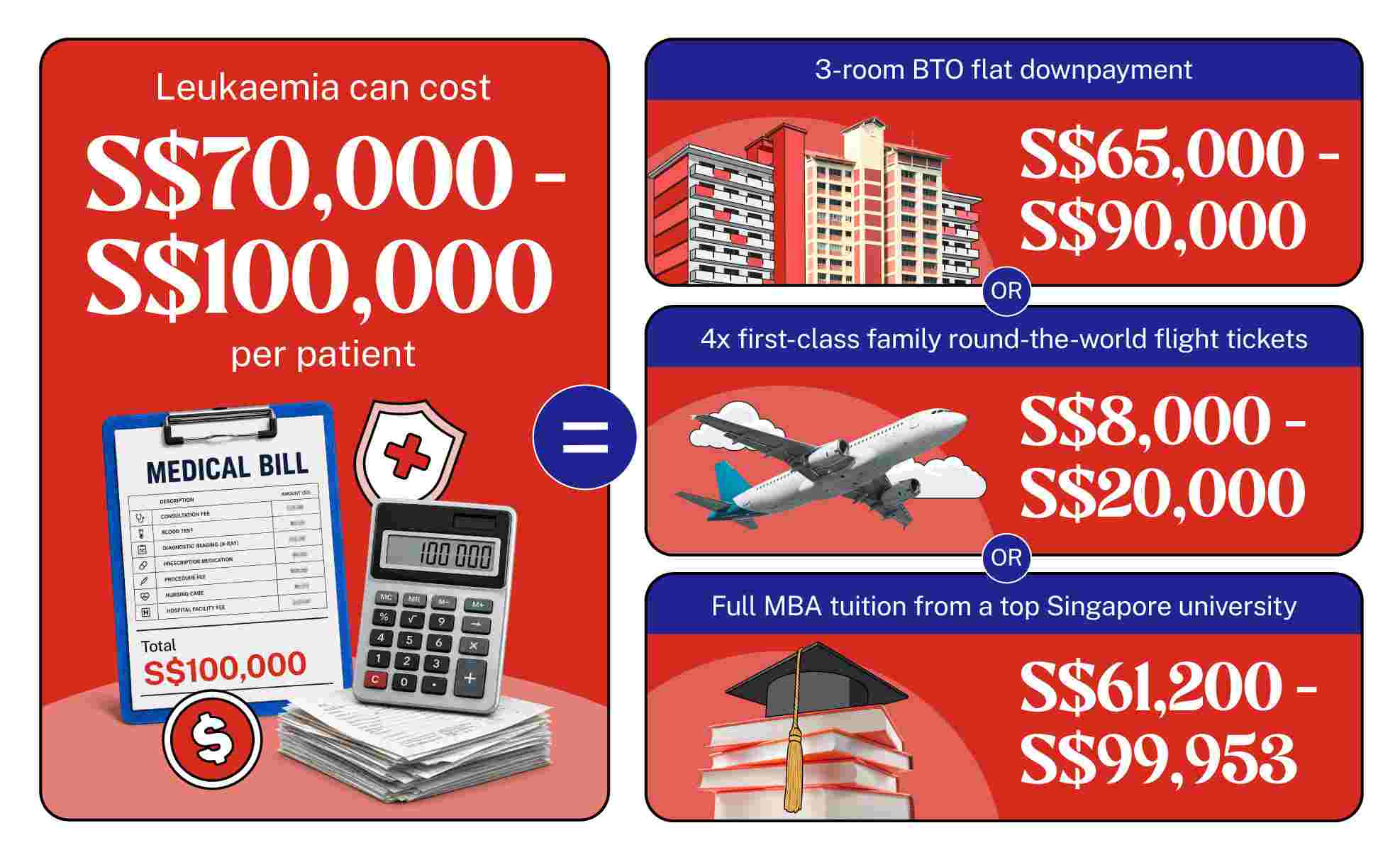
Beyond medical care and hospitalisation bills, cancer also incurs hidden costs, from managing daily caregiving expenses to the potential loss of income.
Early detection can make a big difference, allowing you to opt for simpler or less invasive treatments that cost less, so be sure to get your annual check-ups regularly and protect your finances with comprehensive cancer coverage.
Find out whether you are eligible for subsidised screening under the National Health Screening Programme and fortify your finances against cancer.

Cancer Guard
Be on guard against the financial risk of cancer with a regular premium term plan that provides 100% cash payout upon diagnosis of cancer, regardless of stage.

GREAT Critical Cover Series
Choose the plan that suits your needs and feel assured with 100% lump sum payout upon diagnosis of critical illness at any stage. Be covered against Top 3 Critical Illnesses (cancer, heart attack, and stroke), or enjoy comprehensive protection against 53 critical illnesses.

GREAT SupremeHealth
Be covered at every stage of life with GREAT SupremeHealth, a MediSave-approved Integrated Shield Plan that provides enhanced hospitalisation coverage for higher ward classes at Restructured Hospitals, as well as private hospitals. Complement GREAT TotalCare 2 to reduce your out-of-pocket expenses.



Let us match you with a qualified financial representative
Our financial representative will answer any questions you may have about our products and planning.
