








Why Singapore women may need to plan harder for retirement than men
Financial Planning 101: Women tend to live longer but may retire with less. Here is how to plan for the gap.

What this article covers
- Women may have to fund a longer retirement. A 65-year-old female Singapore resident can expect to live about three years longer than a man of the same age, changing how long her retirement income may need to last.
- The surprising CPF difference many women may not realise. CPF LIFE takes life expectancy into account when calculating payouts, which means the same retirement savings do not necessarily translate into the same monthly payout for men and women.
- Why the gap can start decades before retirement. Differences in earnings, caregiving responsibilities and time outside the workforce can affect CPF contributions and the amount available to save and invest.
- What women can do differently. Rather than simply aiming for a bigger lump sum, women can plan around lifelong income, their own monthly income floor, longer investment horizons and potential career breaks.
A Singaporean man and woman:
- Have the same birthday.
- Hold the same amount of retirement savings.
- Expect to spend the same amount every month.
- Live similar lifestyles.
- And even retire on the same day after turning 65.
You might expect they could have the same retirement plan. But women may need to plan their retirements differently even with the same financial resources as a man.
The first challenge: women's retirement money might need to last longer
According to the latest Singapore Department of Statistics data:
- A male resident who reached 65 in 2025 can expect to live another 19.9 years on average.
- For women, it is 23.1 years.
That is a difference of 3.2 years, or more than 38 additional months of retirement.
For illustration, if someone expects to spend S$2,500 a month during retirement, 3.2 additional years would represent about S$96,000 in additional spending, before accounting for inflation, investment returns or other income sources.
The second challenge: same CPF savings may not mean same CPF LIFE payouts
One less obvious consequence of women's longer life expectancy is that a man and woman with otherwise similar CPF LIFE circumstances may not receive the same monthly payout.
CPF Board states that longer life expectancy results in lower monthly payouts on average, and that males receive higher payouts than females because their average life expectancy is shorter.
This does not make CPF LIFE less valuable for women. Its lifelong payout feature helps protect against the risk of outliving retirement savings.
But women should plan their retirements around the CPF LIFE payouts they are actually projected to receive, rather than using a generic payout calculation.
- Some CPF Board illustrations of CPF LIFE payouts are based on a male member.
- For instance, CPF Board's 2026 illustration shows that someone turning 55 with the Full Retirement Sum of S$220,400 could receive an estimated S$1,780 a month from age 65 under the CPF LIFE Standard Plan. The footnote states that these payout figures are based on a male member.
- For women, a more reliable payout figure can be found using CPF’s Retirement Payout Planner or Monthly Payout Estimator.
The third challenge: women approaching retirement may have lower CPF balances
CPF statistics also reveal another difference. Based on Lifepedia calculations using figures as of 31 December 2025, average total CPF balances were approximately:
- Age above 50 to 55: S$334,000 for men versus S$295,000 for women
- Age above 55 to 60: S$330,000 for men versus S$295,000 for women
- Age above 60 to 65: S$308,000 for men versus S$272,000 for women
Across the three age groups combined, that works out to around S$324,000 for men and S$288,000 for women, or an 11% difference.
There are important caveats:
- The figures are calculated averages from aggregate CPF data, not medians. CPF member counts are published in thousands, so these calculated averages should be read as approximate.
- They show balances across CPF accounts and are not a direct measure of how retirement-ready an individual is.
- Housing choices, CPF usage and employment histories can also differ substantially.
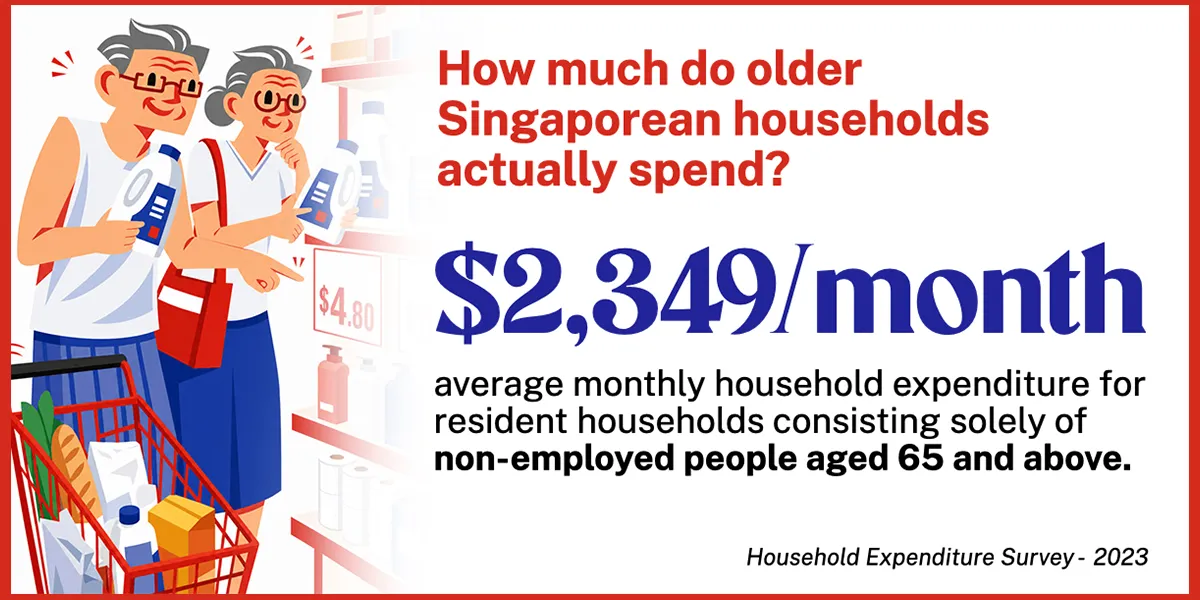
It would be wrong to conclude that the average Singapore woman is automatically 11% less prepared for retirement. But the pattern is still notable: women aged 50 to 65 currently have lower calculated average CPF balances in all three five-year age bands.
Coupled with the fact that women have longer average lifespans, some women may be approaching retirement with less money that needs to support them for longer.
Why can that gap start long before retirement?
The CPF statistics do not tell us why this gap exists. There is unlikely to be a single explanation, but one relevant structural factor is the gender pay gap that has existed through the years.
In its latest published study using 2023 earnings data, the Ministry of Manpower found that full-time female resident employees aged 25 to 54 earned 14.3% less than male employees, before accounting for factors such as occupation, industry, age, education and hours worked.
After adjusting for human capital and labour market factors, the gender pay gap was 6.0%.
Lower income today can extend beyond your working years.
- It may mean lower CPF contributions and, over time, potentially lower retirement payouts.
- There may be less disposable income available for investments.
- Smaller investment contributions also have less time to compound.
Even a difference that appears manageable from one month's pay cheque can therefore accumulate over several decades.
Then there is the financial cost of caregiving
Caregiving adds another layer.
In 2024, around 87,100 Singapore residents were outside the labour force because of caregiving responsibilities. Of these, 85.7% were women.
More recent data provides another perspective. Among residents who were outside the labour force primarily to care for their parents, women made up 59.9% in 2025, down from 72.2% in 2021.
MOM notes that it cannot quantify whether prolonged caregiving disproportionately affects women’s retirement adequacy because it does not track the duration or extent of employment adjustments attributable to caregiving. Even so, any extended reduction in work can potentially affect retirement finances in several ways at once.
- There may be less salary coming in.
- CPF contributions may fall or stop.
- Regular investments may be interrupted.
- Career progression may slow.
- And money that was not invested also loses the future years in which it could otherwise have compounded.
That means the financial cost of a two-year career break is not necessarily limited to two years of lost income. Its effect can still be visible decades later.
The hidden cost of a career break
A career break can affect more than the contributions you miss today. See what those monthly contributions could potentially have grown to by age 65.
1. When does the career break start?
2. How long is the break?
3. How much would otherwise have gone towards CPF, savings or investments each month?
Illustrative value of the missed contributions at age 65
S$23,757A 1-year break beginning at age 30, with S$500 a month no longer being contributed, would mean S$6,000 of contributions are not made.
Illustrative value of the missed contributions at age 65
S$47,513A 1-year break beginning at age 30, with S$1,000 a month no longer being contributed, would mean S$12,000 of contributions are not made.
Illustrative value of the missed contributions at age 65
S$71,270A 1-year break beginning at age 30, with S$1,500 a month no longer being contributed, would mean S$18,000 of contributions are not made.
Illustrative value of the missed contributions at age 65
S$46,584A 2-year break beginning at age 30, with S$500 a month no longer being contributed, would mean S$12,000 of contributions are not made.
Illustrative value of the missed contributions at age 65
S$93,167A 2-year break beginning at age 30, with S$1,000 a month no longer being contributed, would mean S$24,000 of contributions are not made.
Illustrative value of the missed contributions at age 65
S$139,751A 2-year break beginning at age 30, with S$1,500 a month no longer being contributed, would mean S$36,000 of contributions are not made.
Illustrative value of the missed contributions at age 65
S$68,517A 3-year break beginning at age 30, with S$500 a month no longer being contributed, would mean S$18,000 of contributions are not made.
Illustrative value of the missed contributions at age 65
S$137,033A 3-year break beginning at age 30, with S$1,000 a month no longer being contributed, would mean S$36,000 of contributions are not made.
Illustrative value of the missed contributions at age 65
S$205,550A 3-year break beginning at age 30, with S$1,500 a month no longer being contributed, would mean S$54,000 of contributions are not made.
Illustrative value of the missed contributions at age 65
S$19,457A 1-year break beginning at age 35, with S$500 a month no longer being contributed, would mean S$6,000 of contributions are not made.
Illustrative value of the missed contributions at age 65
S$38,914A 1-year break beginning at age 35, with S$1,000 a month no longer being contributed, would mean S$12,000 of contributions are not made.
Illustrative value of the missed contributions at age 65
S$58,371A 1-year break beginning at age 35, with S$1,500 a month no longer being contributed, would mean S$18,000 of contributions are not made.
Illustrative value of the missed contributions at age 65
S$38,152A 2-year break beginning at age 35, with S$500 a month no longer being contributed, would mean S$12,000 of contributions are not made.
Illustrative value of the missed contributions at age 65
S$76,304A 2-year break beginning at age 35, with S$1,000 a month no longer being contributed, would mean S$24,000 of contributions are not made.
Illustrative value of the missed contributions at age 65
S$114,456A 2-year break beginning at age 35, with S$1,500 a month no longer being contributed, would mean S$36,000 of contributions are not made.
Illustrative value of the missed contributions at age 65
S$56,115A 3-year break beginning at age 35, with S$500 a month no longer being contributed, would mean S$18,000 of contributions are not made.
Illustrative value of the missed contributions at age 65
S$112,231A 3-year break beginning at age 35, with S$1,000 a month no longer being contributed, would mean S$36,000 of contributions are not made.
Illustrative value of the missed contributions at age 65
S$168,346A 3-year break beginning at age 35, with S$1,500 a month no longer being contributed, would mean S$54,000 of contributions are not made.
Illustrative value of the missed contributions at age 65
S$15,935A 1-year break beginning at age 40, with S$500 a month no longer being contributed, would mean S$6,000 of contributions are not made.
Illustrative value of the missed contributions at age 65
S$31,870A 1-year break beginning at age 40, with S$1,000 a month no longer being contributed, would mean S$12,000 of contributions are not made.
Illustrative value of the missed contributions at age 65
S$47,806A 1-year break beginning at age 40, with S$1,500 a month no longer being contributed, would mean S$18,000 of contributions are not made.
Illustrative value of the missed contributions at age 65
S$31,247A 2-year break beginning at age 40, with S$500 a month no longer being contributed, would mean S$12,000 of contributions are not made.
Illustrative value of the missed contributions at age 65
S$62,493A 2-year break beginning at age 40, with S$1,000 a month no longer being contributed, would mean S$24,000 of contributions are not made.
Illustrative value of the missed contributions at age 65
S$93,740A 2-year break beginning at age 40, with S$1,500 a month no longer being contributed, would mean S$36,000 of contributions are not made.
Illustrative value of the missed contributions at age 65
S$45,959A 3-year break beginning at age 40, with S$500 a month no longer being contributed, would mean S$18,000 of contributions are not made.
Illustrative value of the missed contributions at age 65
S$91,917A 3-year break beginning at age 40, with S$1,000 a month no longer being contributed, would mean S$36,000 of contributions are not made.
Illustrative value of the missed contributions at age 65
S$137,876A 3-year break beginning at age 40, with S$1,500 a month no longer being contributed, would mean S$54,000 of contributions are not made.
Illustrative value of the missed contributions at age 65
S$13,051A 1-year break beginning at age 45, with S$500 a month no longer being contributed, would mean S$6,000 of contributions are not made.
Illustrative value of the missed contributions at age 65
S$26,102A 1-year break beginning at age 45, with S$1,000 a month no longer being contributed, would mean S$12,000 of contributions are not made.
Illustrative value of the missed contributions at age 65
S$39,153A 1-year break beginning at age 45, with S$1,500 a month no longer being contributed, would mean S$18,000 of contributions are not made.
Illustrative value of the missed contributions at age 65
S$25,591A 2-year break beginning at age 45, with S$500 a month no longer being contributed, would mean S$12,000 of contributions are not made.
Illustrative value of the missed contributions at age 65
S$51,182A 2-year break beginning at age 45, with S$1,000 a month no longer being contributed, would mean S$24,000 of contributions are not made.
Illustrative value of the missed contributions at age 65
S$76,773A 2-year break beginning at age 45, with S$1,500 a month no longer being contributed, would mean S$36,000 of contributions are not made.
Illustrative value of the missed contributions at age 65
S$37,640A 3-year break beginning at age 45, with S$500 a month no longer being contributed, would mean S$18,000 of contributions are not made.
Illustrative value of the missed contributions at age 65
S$75,281A 3-year break beginning at age 45, with S$1,000 a month no longer being contributed, would mean S$36,000 of contributions are not made.
Illustrative value of the missed contributions at age 65
S$112,921A 3-year break beginning at age 45, with S$1,500 a month no longer being contributed, would mean S$54,000 of contributions are not made.
How women can plan for their retirement more deliberately
That is why the answer is not simply: Women need to save more.
A better conclusion is: women may need to design their retirement plans more carefully, which starts with changing what you plan for.
1. Plan for both your household and yourself
Instead of looking at a combined retirement sum for yourself and your spouse, you should ask: How much retirement income would each spouse have individually?
- A couple's expenses do not simply halve if one person dies.
- The surviving spouse may still have to pay for housing, utilities, transport, insurance, healthcare and many other fixed expenses.
For women, knowing their own financial position within the household is important.
- How much CPF LIFE income will you personally receive?
- What savings and investments are in your name?
- What happens to household income if your spouse dies first?
- Which expenses remain?
- What assets, insurance payouts or other income would then be available?
This is not about planning for the worst. It is about recognising that a retirement plan designed for two people may eventually have to support one.
2. Give yourself a planning age, not just a retirement age
Most people know roughly when they would like to retire. Far fewer decide how long their financial plan should be designed to last.
For women, this number can be particularly important.
- If you plan to retire at 65, consider running your plan to at least age 90, and then stress-test it to 95.
You do not need to keep 30 years of expenditure sitting in cash. Instead, ask whether the combination of lifelong income, investments, savings and other assets could continue supporting you under a longer-than-expected retirement.
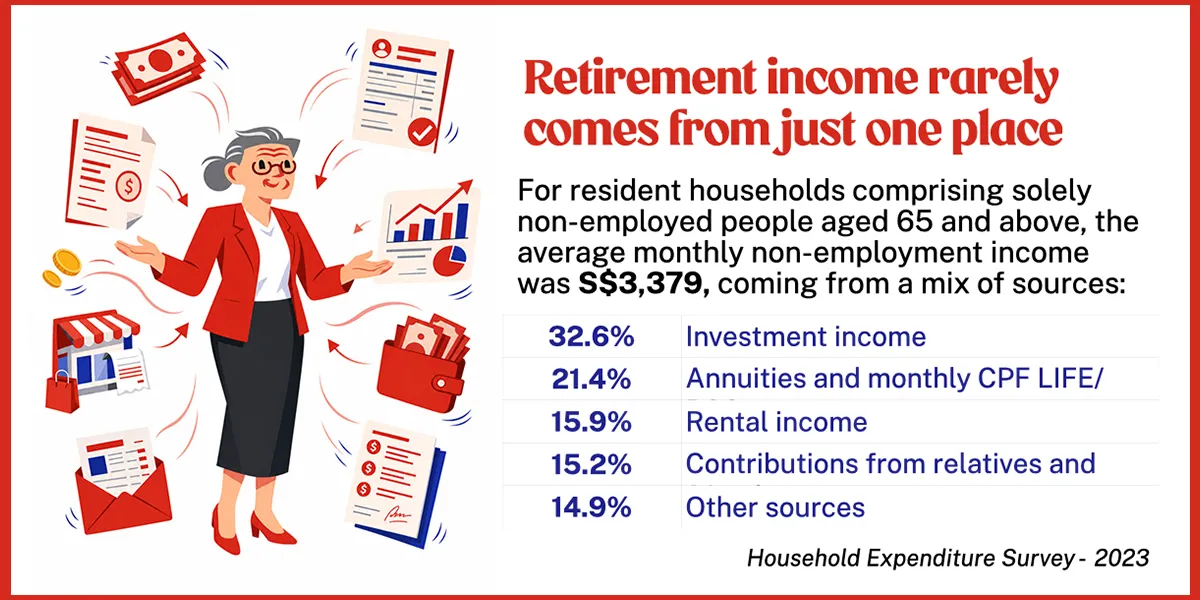
3. Work backwards from income, not just a big savings number
A retirement goal such as "I need S$1 million" sounds reassuringly concrete. But the number on its own tells you relatively little.
Instead, begin with the income you need.
- Suppose you expect to need S$3,000 a month for essential and regular retirement expenses.
- If lifelong income sources cover S$2,000, your remaining problem is very different from someone who needs to fund almost the entire S$3,000 from a finite investment portfolio.
This is where CPF LIFE can form an important part of the plan.
- CPF LIFE provides monthly payouts for life, helping to protect against the risk of living longer than expected.
- Women should check their personal projected payout, especially because CPF LIFE payouts take sex-specific life expectancy into account.
From there, the remaining income gap can be supported through other savings, investments or retirement income sources.
4. Treat a career break as a retirement-planning event too
If you step away from work to care for children, parents or other family members, the immediate household question usually revolves around current cash flow: “Can my family manage with one salary?”
But an important question also worth asking is: what happens to the caregiver's long-term financial position?
Before or during a career break, estimate what is being interrupted.
- How much CPF would normally have been contributed?
- How much were you saving or investing each month?
- Has employer-provided insurance or other benefits changed?
If the household has sufficient financial capacity, working family members can make cash top-ups or CPF transfers to help build a loved one's retirement savings, subject to CPF rules and limits. Alternatively, the caregiver can have a clear catch-up plan after returning to work.
5. A longer retirement may mean some of your money still needs to grow
Living longer can create another counter-intuitive problem:
- It may be tempting to become extremely conservative with all your money as retirement approaches.
- But keeping almost everything in cash for decades leaves purchasing power exposed to inflation.
A woman retiring at 65 may still be planning across 20 to 30 years or more. Your retirement portfolio should therefore have different jobs for different parts of your money.
- Some funds (cash) may need to be readily available.
- Some income (CPF LIFE, annuities, other forms of retirement income) may need to be dependable and lifelong.
- Other money may still have enough time to remain invested for longer-term growth.
The aim is not to chase higher returns. It is to avoid treating a potentially 30-year retirement as though every dollar will be needed tomorrow.
What inflation can do over a 30-year retirement
Your retirement spending may not stay the same for 30 years. See how the cost of maintaining the same lifestyle can change over time.
1. What would your monthly lifestyle cost in today's dollars?
2. Choose an illustrative annual inflation rate
What the same lifestyle could cost
At 2% annual inflation, maintaining a lifestyle that costs S$2,000 a month today could cost about S$3,623 a month after 30 years — roughly 81% more in future dollars.
What the same lifestyle could cost
At 3% annual inflation, maintaining a lifestyle that costs S$2,000 a month today could cost about S$4,855 a month after 30 years — roughly 143% more in future dollars.
What the same lifestyle could cost
At 2% annual inflation, maintaining a lifestyle that costs S$3,000 a month today could cost about S$5,434 a month after 30 years — roughly 81% more in future dollars.
What the same lifestyle could cost
At 3% annual inflation, maintaining a lifestyle that costs S$3,000 a month today could cost about S$7,282 a month after 30 years — roughly 143% more in future dollars.
What the same lifestyle could cost
At 2% annual inflation, maintaining a lifestyle that costs S$4,000 a month today could cost about S$7,245 a month after 30 years — roughly 81% more in future dollars.
What the same lifestyle could cost
At 3% annual inflation, maintaining a lifestyle that costs S$4,000 a month today could cost about S$9,709 a month after 30 years — roughly 143% more in future dollars.
6. Plan for the risks that become more important when you live longer
A longer life does not mean all your years will be in great health. In fact, more years of retirement may create more years in which healthcare, disability or long-term care needs could arise.
As Singaporeans, we already have national schemes such as MediSave, MediShield Life, CPF LIFE and CareShield Life to address different parts of retirement, healthcare and longevity risk.
But these schemes should be considered alongside your own personal savings, investments and existing insurance coverage.
You do not need every possible form of insurance. But you should ask whether a major health event, disability or long period of care could require you to draw down retirement assets much faster than planned.
If you are uncertain about your protection needs or how they fit within your retirement plan, you can speak to a financial representative.
So, do women actually need more retirement money than men?
A woman with substantial savings, strong lifelong income and low expenses can still be considerably better prepared for retirement than a man of the same age.
National averages also cannot predict any one person's retirement.
But at the same time, what the data suggest is that women have good reason to plan harder than men when it comes to their retirement.
Simply copying a generic retirement benchmark may not be enough. And if caregiving or career breaks are likely to form part of your life, include them in your financial plan before they happen.
Frequently asked questions



Let us match you with a qualified financial representative
Our financial representative will answer any questions you may have about our products and planning.
