








Lessons from the world’s happiest retirees
Wealth-Wise 101: What can the world's happiest seniors teach us about retirement planning?
What this article covers
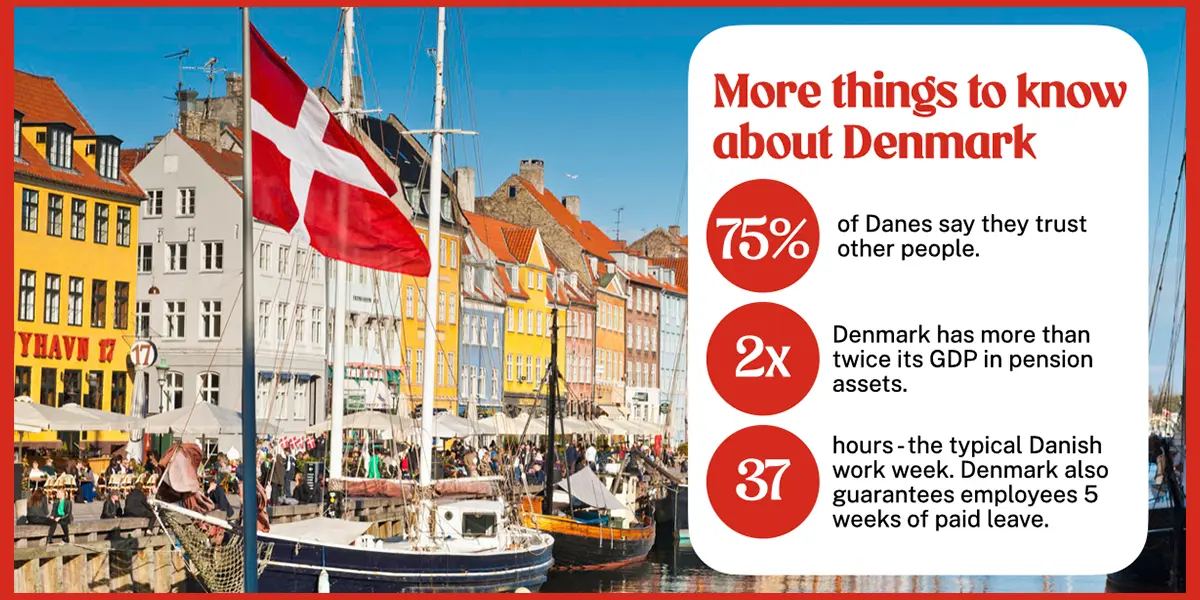
- Why Denmark can claim to have some of the world’s happiest older adults. Denmark ranked first among people aged 60 and above in the World Happiness Report 2024 and remains one of the world’s happiest countries in 2026.
- What money can and cannot do for retirement happiness. Denmark combines a strong retirement income system with low levels of old-age poverty, but financial security is only one part of the picture.
- Why people, purpose and health matter after work ends. Older Danes have particularly high participation in volunteering and community organisations, while most report good health.
- Five practical lessons for Singapore. From building lifelong income to planning an ordinary Tuesday, Denmark offers a different way of thinking
What makes a “good retirement”?
For some of us here in Singapore, your answers may involve a number: How much should you have in your CPF? How much will you need each month? How long will your savings last?
Still, while money is undoubtedly important, research into the country with the world’s happiest seniors suggest finances is just one of many factors to building a great retirement.
In the World Happiness Report 2024, Denmark ranked first in the world for happiness among people aged 60 and above, narrowly ahead of Finland.
Older Danes rated their lives an average 7.916 out of 10. Singapore ranked 26th for the same age group, with an average score of 6.477. The rankings were based on surveys conducted between 2021 and 2023.
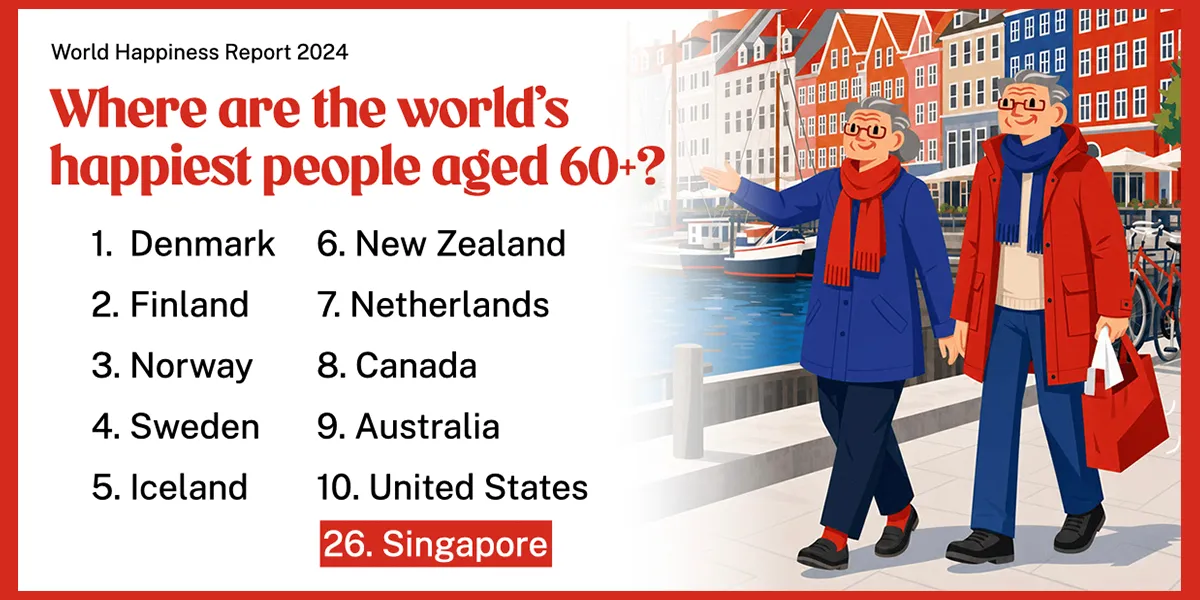
Strictly speaking, this is a ranking of everyone aged 60 and above rather than retirees alone. Not everyone in this group has stopped working. But it is the closest the World Happiness Report has come to a global ranking of happiness in later life.
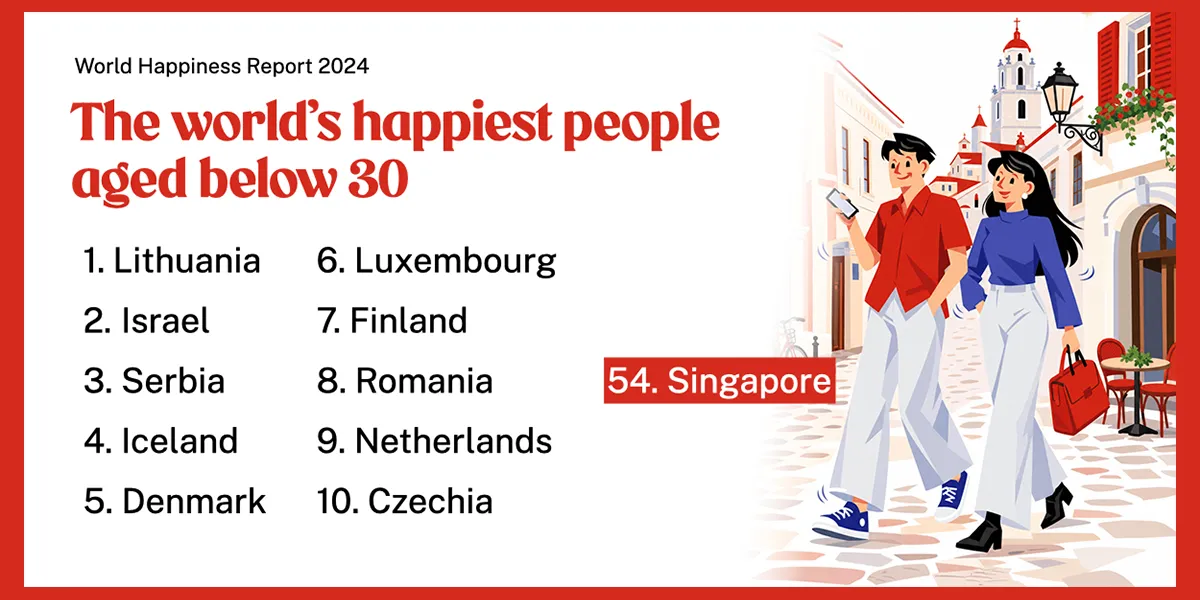
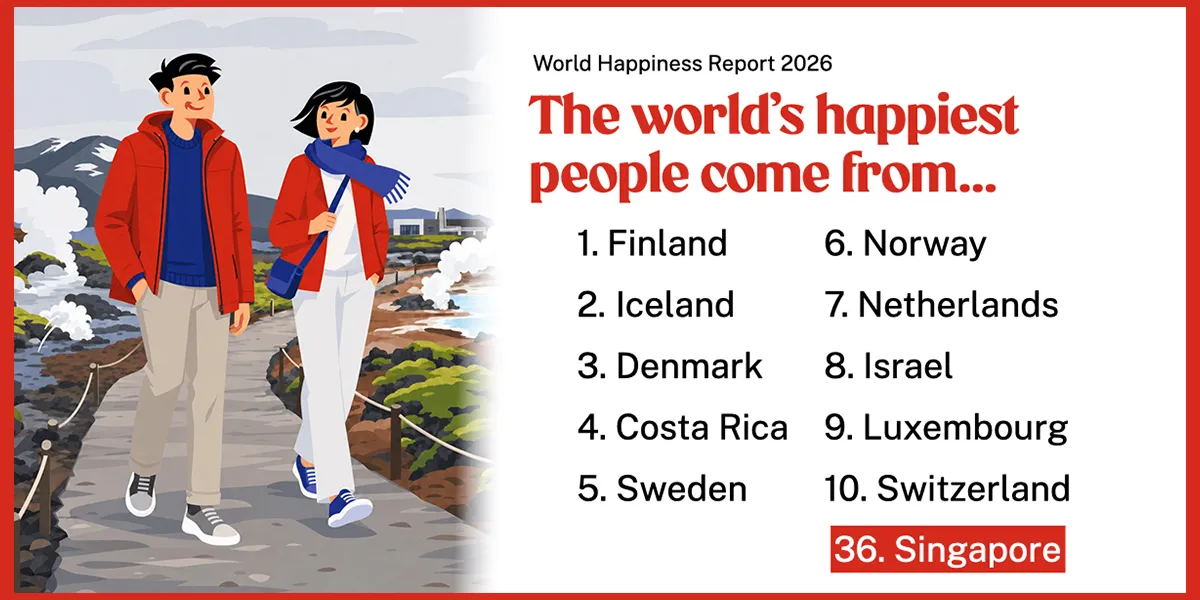
The latest World Happiness Report 2026 for instance no longer publishes the same 60+ ranking. Instead, its age ranking separates people below 25 from everyone else.
Nevertheless, Denmark remains very close to the top. It ranks third in the world overall in 2026 and second among everyone outside the under-25 group, behind Finland.
What is Denmark getting right about retirement/ later life?
There is unlikely to be one secret. But look beyond the happiness ranking and several features of Danish life stand out. And many of these lessons can be applied here in Singapore.
Lesson 1: Build enough lifelong income to reduce worries about lifelong expenses
Money cannot guarantee a happy retirement. Not having enough of it though can make retirement considerably harder.
Denmark has built much of its retirement system around providing income from several sources. Its system is generally described in three parts:
- State pension and the ATP Lifelong Pension
- Pensions accumulated through employment
- Voluntary individual pension savings
According to Organisation for Economic Co-operation and Development (OECD) estimates, under its standard model, a full-career Danish worker earning an average wage could receive mandatory pension benefits equivalent to around 72.7% of their previous gross earnings at retirement. The projected replacement rate is even higher for lower earners.
This does not prove that pensions alone make Danes happy. But there is a useful retirement lesson here: A good retirement plan should turn accumulated wealth into reliable income.
It is easy to become fixated on the size of your retirement pot (S$500,000, S$1 million, S$2 million), but eventually, that money has a job to do. It needs to pay for next month’s groceries, bills ten years from now and everyday expenses at an age when you may no longer want, or be able, to return to work.
What this means in Singapore
CPF LIFE already provides an important version of lifelong income.
For members turning 55 in 2026, for example, the Full Retirement Sum is S$220,400. Setting this amount aside at age 55 could provide an estimated S$1,780 a month from age 65 under the CPF LIFE Standard Plan, based on CPF Board’s stated assumptions. Actual payouts depend on factors including your savings and when you start receiving them.
Other savings, investments, annuities or sources of income can then sit around this foundation.
Lesson 2: Do not retire from your community
Here is perhaps the most striking Danish statistic:
- In 2024, 18% of Danes aged 65 to 74 volunteered every week.
- Among those aged 75 and above, the figure was even higher at 26%.
- Comparatively, across the entire Danish adult population, only 14% volunteered weekly.
Older Danes are also unusually active members of clubs and associations.
- About 57% of those aged 65 to 74 belonged to at least one association outside the workplace.
- Among those aged 75 and above, membership rose to 69%.
- That compares with 26% to 32% among people between the ages of 25 and 64.
The data suggests a very different picture of retirement from simply having more free time: These older adults have somewhere to go, people to see and something to contribute.
That matters because retirement can quietly remove much of the social structure accumulated during working life.
For decades, you may have colleagues around you five days a week. There are conversations over lunch, people who ask for your opinion, meetings you need to attend and a reason to leave home in the morning.
Then work stops. Your financial plan may be perfectly intact, but a large part of your social life disappears.
Think beyond “keeping in touch”
The Danish experience suggests that informal friendships may not be enough. A recurring activity creates structure.
- It could mean volunteering every Thursday.
- Playing badminton every Tuesday.
- Helping at a community organisation.
- Joining a walking group.
- Taking a regular class.
- Or simply having a standing lunch with the same group of friends every week.
The activity itself may be less important than the fact that there are people expecting you to turn up.
Singapore’s push towards active ageing similarly puts emphasis on helping seniors remain socially connected and participate in their communities.
The key takeaway here is that your retirement plan should contain something most financial plans do not: a social calendar.
Lesson 3: Plan to be needed by someone
Volunteering also offers another clue about Danish retirement: It may not be enough simply to have people around you during your retirement. Instead, it is also about finding a sense of purpose.
Among Danes aged 75 and above, 16% undertook voluntary work specifically in the social sector in 2024. Older adults were also increasingly likely to belong to charitable, social or humanitarian organisations.
During our working life, we may have a sense that what we do matters to somebody else.
- People ask for your help.
- They rely on your experience.
- There are problems you know how to solve.
- There are things you are responsible for.
When we retire, not only do we lose our salaries, but our sense of usefulness and purpose may also go missing. A fulfilling retirement as such requires finding another source for it.
That does not mean only filling retirement with unpaid work. Instead, purpose can be much smaller and more personal, like:
- Mentoring someone.
- Helping to organise activities at a community group.
- Cooking for your family.
- Caring for a garden.
- Learning something difficult.
- Becoming the person who arranges the monthly meal that keeps a group of old friends together.
Try asking yourself: “Who will need my help when I retire?” The answer can reveal something a retirement calculator cannot.
Lesson 4: Protect what your body allows you to do
Most retirement plans often assume having enough money gives you freedom. Yet, another asset actually plays a more critical role in how much freedom you will have: your health.
More than three-quarters of Danes aged over 65 describe their health as excellent, very good or good, according to Denmark’s Health Authority.
Good health can affect whether older people can participate in communities, take part in meaningful activities or maintain their independence.
- When thinking about the next 20 or 30 years, consider investments in your future health alongside your financial investments.
- That can include regular exercise, preventive health screening, adequate sleep, maintaining a healthy diet and addressing medical issues before they begin to restrict your everyday life.
Retirement planning should not ask just how many years your money can last. It should also ask how you can stay well enough to enjoy those years.
Lesson 5: Plan an ordinary Tuesday, not just the holidays
Picture retirement and it is easy to imagine the highlights.
- A long holiday in Japan.
- More time with the grandchildren.
- Lunches with friends.
- Finally doing the things you never had time for while working.
But retirement is not a long holiday. Eventually, it becomes everyday life. There will be Mondays, Tuesdays and rainy afternoons when nothing special is happening.
This may be another lesson hidden within Denmark’s high participation in volunteering, associations and community life: A satisfying retirement needs rhythm.
Money gives you the freedom not to go to work. It does not tell you what to do instead. Try a simple exercise: Imagine an ordinary Tuesday when you are 70.
- What time do you wake up?
- Do you have somewhere to go?
- Who will you speak to?
- Will you exercise?
- Is anyone expecting to see you?
- Is there something you are responsible for?
- What are you looking forward to that evening?
If your retirement plan has detailed answers for your finances but none for those questions, there may still be some planning left to do.
The world’s happiest retirees are not happy all the time
Although there are lessons to learn from Denmark, there is also a danger to taking its example too far.
Denmark has not eliminated the challenges that come with ageing. Nor should we assume that pensions, volunteering or being part of a club are the only reasons why Denmark topped the happiness ranking.
Even the World Happiness Report cautions against drawing simplistic conclusions from the factors associated with happiness. Relationships can work in both directions: a supportive social environment can contribute to wellbeing, but happier people may also find it easier to form relationships, participate and cooperate.
Nevertheless, while there is no secret Danish formula to copy, the basic principles are useful to consider:
- Enough financial security to feel safe.
- Enough health to remain independent.
- Enough relationships to feel connected.
- Enough purpose to feel useful.
- And enough control over your time to spend it on things that matter.
Putting it into practice, alongside “Will I have enough money?”, consider asking yourself:
- Who will I spend my time with?
- What will keep me moving?
- Where will I still belong?
- Who will need me?
- What will an ordinary Tuesday look like?
Those answers may turn out to matter just as much as the number in your retirement account.
If you are planning for retirement, a financial representative can help you understand how your savings, insurance protection and expected sources of retirement income could work together to support the retirement lifestyle you have in mind.
Frequently asked questions

Read more like this


Let us match you with a qualified financial representative
Our financial representative will answer any questions you may have about our products and planning.
