





How to save for retirement: lessons from financial experts
Wealth-Wise 101: What Warren Buffett, John Bogle and other experts can teach us about retiring well in Singapore

What this article covers
- Why experts think in monthly income, not a big number. A Nobel laureate's view on the hardest part of retirement, and how CPF LIFE fits in.
- Why time matters more than talent. How compounding rewards those who start early, and why the famous "eighth wonder of the world" quote is probably not Einstein's.
- Why low costs and calm behaviour may matter more than stock picks. What investors like Warren Buffett, John Bogle and Benjamin Graham agree on.
- How to plan for a longer life and a fuller one. What the latest Singapore life-expectancy data suggests, and why retirement is about more than money.
Saving for your retirement, or building a sold retirement fund, does not need a magical secret strategy or the very best investment picks, at least according to some of the world's most respected investors.
Instead, what most financial experts actually advise is to develop good personal financial habits from a young age, which lay the foundations for a better retirement in the future.
Among these habits include starting your retirement planning early, keeping costs low, staying calm, and planning for retirement income instead of a lump sum retirement amount.
Here are what people like Warren Buffett, John Bogle and Nobel laureate William Sharpe have to say on the topic and how to apply these lessons in Singapore.
Why do experts say to start saving for retirement early?
In his 2008 biography The Snowball, former Berkshire Hathaway CEO Warren Buffett, was quoted to have said: "Life is like a snowball. The important thing is finding wet snow and a really long hill."
In this analogy, your money is like the “snowball”. The "long hill" is time. As your “wet snowball” rolls down the hill, it grows larger by picking up more snow along the way.
With time, your money, or the “wet snow”, can earn returns on its past returns, and the longer that runs, the more it may add up.
Time can do most of the heavy lifting when it comes to growing your money. But it is also the one ingredient you cannot buy back later.
- What does starting 10 years earlier look like?
Assuming a steady 4% yearly return after costs, a simple illustration might look like:
- Save S$500 a month for 30 years: you put in S$180,000. The total may grow to about S$347,000.
- Save S$500 a month for 20 years: you put in S$120,000. The total may grow to about S$183,000.
The extra 10 years added S$60,000 in savings but produced a S$164,000 increase to the final sum.
Of course, real returns will go up and down. But the point is: early, regular saving gives growth more time to work.
You may:
- Consider setting up an automatic monthly transfer to your savings or investments every payday.
- Start with an amount you can keep up, even if it feels small. You can raise it later.

Why you should plan for retirement income instead of a retirement amount
Many people are obsessed with a retirement figure like “I need S$1 million to retire”.
But while a big lump sum can sound reassuring, for most of us, a steady flow of money each month (a retirement income) actually does more to pay for our day-to-day living.
Trying to turn your savings (or a lump sum retirement amount) into working retirement income can be "the nastiest, hardest problem in finance”, according to economist William Sharpe, who won the Nobel Prize in 1990 for his work on risk and return.
This is because you also must plan for things no one can know for sure, such as:
- how long you will live
- how markets will perform, and in what order
- how fast prices will rise
- what your health and care needs will be
- How does CPF LIFE help with this?
In Singapore, CPF LIFE payouts already works as a form of monthly retirement income. But dependent on your needs, your monthly CPF LIFE payouts may only be enough to cover essential spending, and not additional lifestyle-related expenses.
As such, you may wish to consider using other savings, investments and retirement income sources to fund the lifestyle you want in retirement.
- What can you do this month?
- Estimate the monthly income you would like in retirement, not just a total sum.
- Split it into essentials (housing, food, utilities, healthcare) and lifestyle (travel, hobbies, gifts).
- Use the CPF retirement payout estimator to see how much of the essentials CPF LIFE may cover.
What is the biggest risk to your retirement savings?
“The investor's chief problem, and even his worst enemy, is likely to be himself,” said Warren Buffet’s long-time mentor Benjamin Graham, who also wrote the book The Intelligent Investor.
Often our own actions can cause more than damage to our retirement funds than a poor investment choice. For instance: selling in a panic when markets fall or chasing whatever has just gone up.
- Why do people make these mistakes?
- Losses feel sharper than gains. A 20% fall can feel far more painful than a 20% rise feels good, which can push people to sell at the worst time.
- Recent events feel permanent. After a strong year, it is easy to assume it will continue. After a crash, it is easy to assume it will never recover.
- Checking too often raises anxiety. Daily price swings are mostly noise for money you will not need for decades.
- How can you protect yourself from yourself?
The experts' answer is usually to decide what you want to with your money in advance, when you are calm.
- Automate your saving and investing, so it happens without a fresh decision each month.
- Write down your plan, including what you will do if markets fall by 20% or more.
- Keep an emergency fund in cash, so you are not forced to sell investments at a low point to cover a sudden bill.
- Review on a schedule, such as once or twice a year, rather than whenever the news is frightening.
How long should you plan for your retirement to last?
Many experts suggest planning well past the average life expectancy, because many people will live well beyond it.
According to the Singapore Department of Statistics (SingStat), residents aged 65 in 2025 could expect to live to 86.6 years on average.
- For women aged 65, the figure was 88.1 years.
- For men, it was 84.9 years.
Someone retiring at 65 may need their money to last more than 20 years, possibly 30 or more.
- Why does a longer life change the plan?
- Inflation has longer to work. Even modest price rises can shrink what a fixed sum buys over two or three decades.
- Health costs tend to rise with age. Hospital stays, chronic conditions and long-term care may become larger items later in life.
- Spending changes shape. Many retirees spend more on travel and activities early on, then more on health and care later.
This is one reason lifelong income, such as CPF LIFE, can be valuable. It keeps paying however long you live.
- What can you do this month?
- Plan for your money to last to at least your mid-90s, rather than to the average age.
- Review your hospitalisation cover, and check whether it is likely to stay affordable as premiums rise with age.
- Understand what CareShield Life, ElderShield, or other forms of private insurance may cover for severe disability, and consider whether that meets your needs, depending on your budget and existing coverage.
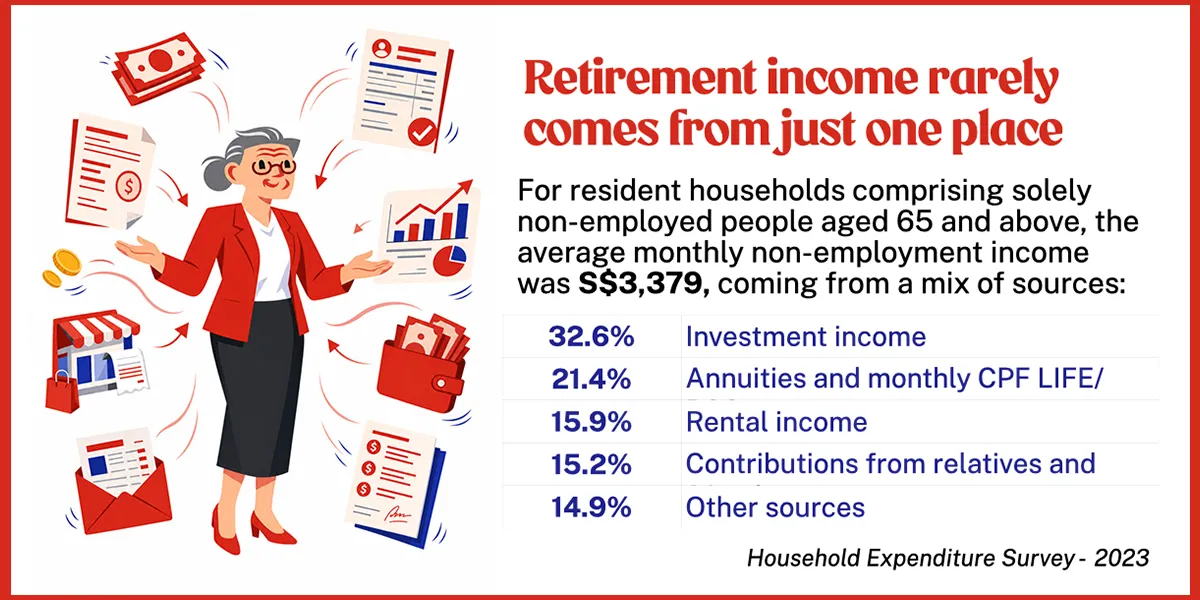
Is retirement planning only about money?
Money is the means, not the goal. Morgan Housel, author of the bestselling The Psychology of Money (2020), argues that the real reward of money is control over your time.
In the book, he writes: "The ability to do what you want, when you want, with who you want, for as long as you want, is priceless. It is the highest dividend money pays."
Seen this way, a retirement plan is really a plan for freedom. The numbers matter because they protect your choices.
- What does this mean in practice?
- Your spending plan becomes more realistic. It is easier to estimate costs when you know what your days will look like.
- You may keep working, in some form. From 1 July 2026, Singapore's retirement age rose to 64 and the re-employment age to 69. Part-time or flexible work can add income, structure and social contact.
- Health becomes part of the plan. Staying active and keeping up with health screenings may help you enjoy more of the years you are saving for.
- What can you do this month?
- Write down how you would like to spend a typical week in retirement.
- Add the costs of those activities to your retirement income estimate.
- Talk it through with your partner or family, since their plans may shape yours.
Five-question quiz
How well do you know retirement in Singapore?
Some retirement rules are not as straightforward as they seem. Choose an answer to reveal the explanation.
Key takeaways: How to apply these lessons in Singapore
The good news is you may already have more than you realise. Singapore's system gives many people a foundation that the experts above would recognise.
- Start early (Buffett's long hill): CPF contributions build retirement savings automatically from your first job. Voluntary top-ups and regular personal saving can add to that.
- Plan for income (Sharpe's hardest problem): CPF LIFE provides a monthly payout for life from age 65, which can serve as your income floor.
- Manage your behaviour (Graham): An emergency fund in cash, usually several months of expenses, may help you avoid selling investments at a bad time.
- Plan for a long life: Review health and long-term care cover as you age, so it stays suitable and affordable.
- Plan your time (Housel): Consider how work, family, health and interests fit into the retirement you want.
What is a simple 30-day starting plan?
- Week 1: Log in to your CPF account and note your current balances and estimated CPF LIFE payout.
- Week 2: Estimate the monthly income you would like in retirement, split into essentials and lifestyle.
- Week 3: List your other savings, investments and insurance, and check the fees you pay.
- Week 4: Set up one automatic habit, such as a monthly transfer to savings or investments.
If you need personalised advice for your situation, you may wish to speak to a financial representative.
Written by: Great Eastern Lifepedia team
Frequently asked questions

Read more like this



Let us match you with a qualified financial representative
Our financial representative will answer any questions you may have about our products and planning.
